
June 19, 2026 · 4 min read
Treat AI like a hire, not a tool
The brands winning with AI aren't using more of it. They are managing it like an employee.
Right now the loudest pitch in CPG is some version of this:
"AI agent. Replaces the human. Works 24/7. No headcount required."
I have seen a dozen of these in the last month. Agents that run your Amazon listings. Agents that manage your retail shelf. Tools that turn one prompt into hundreds of videos a day.
The promise is always the same. You will not have to manage it.
That promise is exactly why most of it is failing.
The part being sold is the part that breaks
Last year MIT studied hundreds of corporate AI efforts. 95 percent produced no measurable return. Gartner expects more than 40 percent of agentic AI projects to be canceled within two years.
The interesting part is why. It was not the models. The models work. The projects failed on integration. On context. On the boring work of fitting the AI into how the business actually runs.
In other words, they failed the way a bad hire fails. Not because the person was not smart. Because nobody managed them.
That is the reframe I want to hand you.
AI is not software you install. It is the fastest, most confident, most junior employee you will ever hire. And like any junior hire, it will do the wrong thing at scale until someone manages it.
How I learned this
Early on, building the AI operating system for my own CPG brand, NØRSE CØDE, I gave an agent a cleanup job. Part of that job needed a delete function, so I gave it one. Then I did the thing you should never do with a new hire. I let it run unsupervised.
It deleted a record and got back a response saying fifty things had been removed. It read that as success and kept going. It had no way to know the count was wrong. So it looped. Again, and again, over two hundred times in one unattended run, confidently deleting until close to four hundred records were gone. Mid-sequence. Unrecoverable.
The agent was not broken. It did exactly what an eager, literal, brand-new employee does when you hand them the keys to production on day one and walk out of the room. It never thought it was failing. It thought it was working.
I did not swear off AI after that. I started managing it. Now nothing destructive runs in my systems without three things first: a backup, a test on a single record, and my explicit sign-off before it is allowed to repeat. Probation, basically. The same thing you would give any new hire before letting them near the whole database.
Why "no management" is the tell
So when I see a tool sold on "no humans needed, no headcount required," I do not hear efficiency. I hear an unmanaged employee with production access.
Removing the worker does not remove the work. It hides it. The decision the human used to make still has to be made well. If no one is accountable for whether the AI made it well, you have not saved the management. You skipped it. And skipping it is how you land in the 95 percent.
The cost of an AI hire is not the subscription. It is the same cost as any hire: the judgment to give it the right job, and the discipline to check its work.
The other camp is also half right
There is a second loud voice in CPG right now. The backlash.
A New Jersey snack brand, Chookie, dropped its AI ads and went fully handmade. Cardboard planes. Puppets. A treehouse for its shipping team. It pulled in around twelve times the followers for about the same effort. The founder's line stuck with me: people "were not rewarding polish. They were rewarding effort. Humor. Tiny human decisions."
It is tempting to read that as "use less AI."
That is the wrong lesson. Chookie did not swear off AI. They fired an employee that was bad at the job and replaced it with one that was good. That is not abstinence. That is performance management.
The question was never how much AI. It is who is managing it.
How to manage an AI hire
You do not need an AI department. At a brand doing a few million to ten million, you need the same things you would give a promising, slightly reckless new employee.
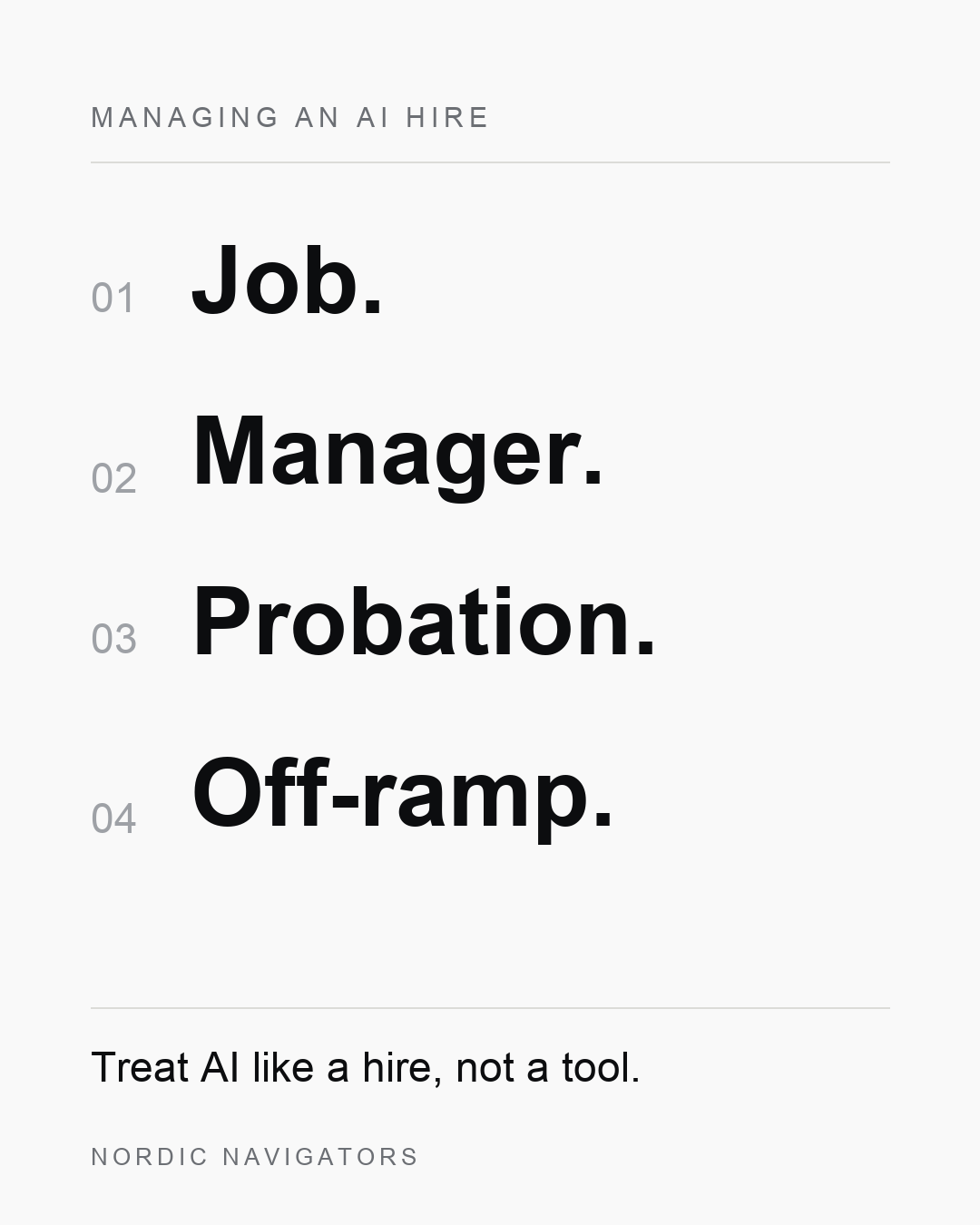
A real job. One clear task, not "go use AI."
A manager. One person who owns its output and actually reads it.
A probation period. It does not get production access on day one. It earns trust on small, reversible work first.
A way to be fired. If it is still bad at the job after you have managed it properly, you replace it. No sunk-cost loyalty to a tool.
Job, manager, probation, off-ramp. The same four things that make a human hire work.
The takeaway
The brands that win with AI over the next two years will not be the ones that adopted the most of it. They will not be the ones that proudly refused it either.
They will be the ones who treated it like hiring. Who gave each AI a job they could describe in a sentence, a human who owned it, and a probation period before it touched anything that mattered.
Stop shopping for AI tools.
Start writing job descriptions.
CPG AI Map Session
Fix the CPG workflow that keeps stealing your week.
I map the recurring reporting or operating workflow first, then build only when the first useful fix is clear.