By Smári Ásmundsson · · 6 min read
AI Search Optimization Agency: How a CPG Brand Judges One Before Hiring
How should a CPG brand judge an AI search optimization agency before hiring one?
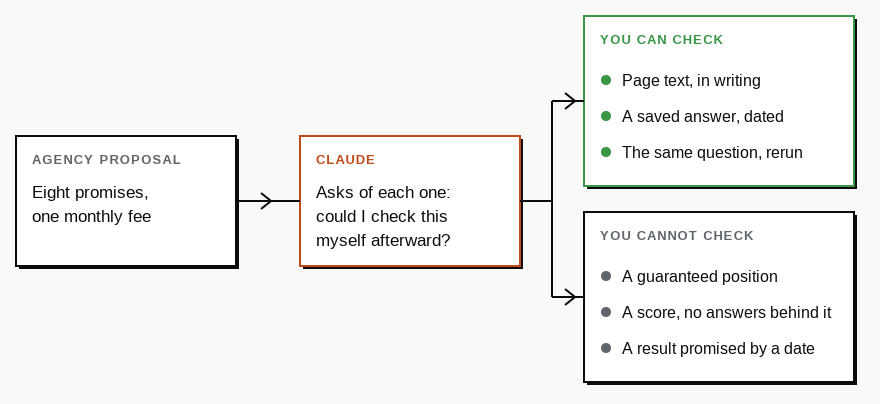
A proposal lands from an agency that says it will get your brand recommended by ChatGPT. It has a monthly fee, a 90 day timeline and a report each month. You cannot tell which of those promises you will ever be able to check. Judge the agency by that. A promise tied to a named question, a named assistant and a date can be tested. A promise of a ranking, a score or a result by day 90 cannot, because the agency does not run the assistants. Hire on the first kind, and ask for the second kind in writing before you do.
Which promises can an AI search optimization agency actually prove?
An agency can prove anything that leaves a trace on your own pages or in a saved answer. It can show the page as it was and as it is now. If the proposal says it will rewrite your ingredient panel as text, you open the page and read the text. That is a promise you can test in a minute.
It can also show you what an assistant said. A saved answer carries the exact question, the assistant that was asked and the date. You can type the same question into the same assistant yourself and compare. Expect different wording, because an assistant gives different sentences when you ask twice. What should hold is the substance: which brands come up and which facts about your product are stated. A before and after on twenty questions, kept as full answers, is proof. A line on a chart is not.
What an agency cannot prove is what it does not control. The answers are written by the assistant, so a promise of a position in an answer is a promise about someone else's work. A promise of a result by a date fails for the same reason. A link from a mention to sales needs your orders, and a proposal that has not asked to see them is guessing. Each of these can still be sold honestly as effort: "we will work on your pages and report each month what the assistants say." None of them can be sold honestly as an outcome.
How do you grade an agency proposal in a minute?
In the older days you would read the proposal twice and list every promise in a spreadsheet beside what it would take to check it. Then you would write the questions to send back, and wait a few days for a friend who runs a brand in your category to tell you whether it sounds right. That is an afternoon of your time and a week of waiting on other people.
Today, your ops manager, or whoever handles your software, pastes the proposal into Claude, an AI chat assistant like ChatGPT. It is a chat box with nothing to set up, and the scorecard is back in about a minute. You read it and decide which questions to send to the agency. This is what comes back for an example proposal, the first four of its eight promises:
| Promise in the proposal | Testable? | Proof to ask for before paying |
|---|---|---|
| "Your brand recommended by ChatGPT within 90 days" | No | None exists. Ask what they will measure at day 90 instead, as named questions. |
| "Rewrite your product pages so assistants can read them" | Yes | The new page text in writing, before it goes live. |
| "A proprietary AI visibility score, reported monthly" | No | The full saved answers behind each score, with question, assistant and date. |
| "Competitor benchmarking" | Partly | Which competitors, which questions and how many answers for each. |
Verdict: ASK FIRST. One of the four promises can be checked as written and one more partly. The scorecard ends with five questions to send back, built from the last column of the table, and the first is "which questions will you ask, and which assistants?"
A prompt is the instruction you type into the chat box. Whoever pastes it puts the proposal under the last line. Your part is reading the table and choosing which questions to send.
Below is a proposal from an agency that says it will improve how AI assistants such as ChatGPT and Perplexity talk about a food or drink brand. Grade it using only what I paste. Do not use anything you know about the agency from outside.

Make a table with one row for every promise in the proposal, with three columns:
1. The promise, quoted in the agency's own words.
2. Testable. YES if I could check it myself afterward by opening a page, or by asking a named question to a named assistant on a named date. NO if it depends on something the agency does not control, or has no measure attached. PARTLY if it could be tested but the proposal leaves out what would be measured.
3. The proof to ask for before I pay, in one sentence. For a NO, the question to put back to the agency.

Then list every red flag, quoting the sentence: a guaranteed position or ranking, a score with no saved answers behind it, a result promised by a date, a fee that does not depend on anything delivered, a method the proposal does not describe.

Then name which parts of the fee cover work my own team could do with an AI chat assistant, such as asking assistants a buyer's questions and saving the answers, or rewriting product page text so every fact is in words.

Finish with a one-word verdict: HIRE if every promise is testable, ASK FIRST if some are, PASS if most are not. Then give the five questions I should send back, in order.

[paste the proposal underneath this line]
Which red flags show up in a proposal?
Five are worth looking for, and each is a promise that cannot be checked, written to read like one that can.
A guaranteed position. The assistant writes the answer, so a guarantee is a promise about someone else's work.
A score with nothing under it. A number out of 100 tells you the agency measured something, not what. If the full answers are not behind it you cannot repeat the check, and a number you cannot repeat is an opinion.
A date on a result. "Within 90 days" puts a deadline on something the agency does not control. Dates belong on work: pages rewritten by day 30, the first full set of saved answers by day 14.
A fee that moves with nothing. A flat monthly fee is fine when the proposal lists what you receive each month. When it lists only effort, you are paying for hours.
A method nobody will describe. Ask how they check what an assistant says about your brand. An agency working carefully can say in a paragraph what it asks, where and how often. If the answer is that the method is proprietary, you are being asked to pay for a result you have to take on faith.
What can your own team do with AI before hiring anyone?
Two of the jobs agencies sell are ones you can run this month. The first is finding out whether assistants name your brand. Brand visibility in AI search: how a CPG brand checks it and what moves it walks through it: six questions, three assistants, one scorecard. The second is page text. If your ingredient panel is a photograph, an assistant reads a file name where your numbers should be, and your product page has two readers shows how Claude drafts the fix.
If the proposal's fee is mostly those two jobs, you are being asked to pay for something you can do before the next call. What is left for an agency is the work that has to happen every month across many pages and listings, and a record you can read. If you are weighing a software tool and not an agency, grading it first is the same exercise for software.
Send the five questions back before you reply to the proposal. An agency that answers them in writing has given you something to hire on. One that answers with a call has not.
CPG AI Assessment
Fix the CPG workflow that keeps landing back on your desk.
I map the recurring reporting or operating workflow first, then build only when the first useful fix is clear.