By Smári Ásmundsson · · 9 min read
Your product page has two readers
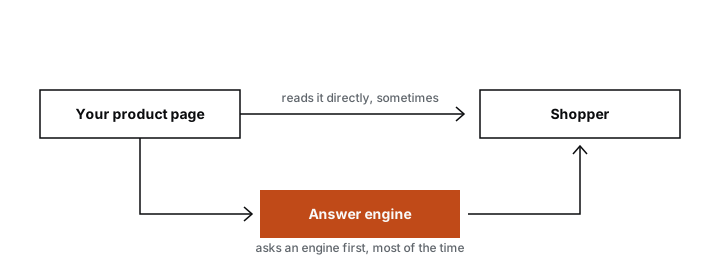
Your product page has two readers now and only one of them buys. The one that does not buy decides what the other one is told about you.
A shopper asks ChatGPT whether your product contains the one thing they will not buy. They never open your site. They read the answer they get, and they either add to cart or they move on.
That answer came from somewhere. Usually your product page, sometimes a retailer listing, sometimes a comparison post written by somebody selling against you. Whichever it was, the answer engine read it, summarised it, and spoke with complete confidence in front of a buyer you never saw arrive.
So your product page has two readers now. One of them buys. The other one decides what the first one is told about you before they ever get there.
How do you check what an answer engine says about your product?
Finding out what it currently says takes about ten minutes. Open ChatGPT or Perplexity, paste your product URL, and ask four things: what is this, what is in it, what does it cost, who is it for. Then read the answer the way a buyer would.
Why the panel on the back of the pack goes missing
Whatever it gets wrong, it will probably not be your marketing copy. That part is written out in words and it gets read cleanly. It is the panel on the back of the pack that goes missing, the ingredients or the nutrition table or the specification, because on most product pages that panel is a photograph. When ChatGPT goes and reads your page it takes the words, and your panel image arrives as a file name. The numbers inside it were never there to read.
How do you fix the page text?
In the older days the fix looked like this. You would open ChatGPT or Perplexity yourself, paste your product URL, and ask the four questions by hand. Then you would sit with your own knowledge of the product and work out which answers were wrong, go back to the page and guess which facts only exist as a photograph, and start typing replacement text from scratch. A careful founder gives that most of a morning. A busy one never gets back to it, because nothing on the calendar forces the return trip.
Today, give this prompt, a written instruction you hand an AI tool instead of writing the fix yourself, to Claude, and it does the reading, the diagnosis, and the first draft of the fix in under a minute:
I'm going to paste my product page below (or give you its URL). Acting as an AI shopping assistant like ChatGPT or Perplexity would, answer four questions using only what's on the page: what is this product, what is in it, what does it cost, and who is it for. Then tell me, separately:
1. Which of those four answers you got wrong or could not find at all.
2. Which of the missing or wrong facts you suspect live only inside an image on the page rather than in its text. Ingredient panels, certification badges and pricing graphics are the usual culprits, and they typically show up as a caption, the hidden label a page carries for a picture, or nothing at all, rather than a real sentence.
3. For each fact in category 2, write the exact plain-text sentence I should add to the page next to the image, using only what I pasted below.

[paste your product page text, or its URL, underneath this line]
What used to be a morning of squinting at your own page and guessing is now a minute of waiting on Claude, and what comes back is finished text: sentences you paste next to the image exactly as they're written, not instead of it, so the design does not have to change. That paste is the whole rest of the job, not a project you hand off to someone else's afternoon. Re-run the same prompt once the text is live and check the same wrong answers again; a fact the engine still misses after it is sitting in text usually means the phrasing was ambiguous, not that the page failed to load. Note the date you checked. Check again next quarter.
None of that is a rebuild. It is a text block on a product template, and posting it takes minutes, not the morning of guessing that used to come before it.
Who does the answer engine cite instead of you?
Fixing your own page this way does not close the gap by itself, and this is the part that is easy to miss. The answer engine is not reading only you. If a retailer listing or a competitor's comparison post already has your panel typed out in plain text, that page keeps winning the citation even after your own page is fixed, because the engine reaches for whichever source answered the question most plainly, not whichever source owns the product. Fixing your page stops you handing the citation away by default. It does not take back a citation that a different page already earned. The second check, right after your own site, is what the top answer currently cites when it is not you.
In the older days that second check was a longer job than the first one. You would ask the answer engine the category question instead of the brand name, the kind a shopper actually types: which sunscreen is reef safe, which dog food has no chicken in it, whatever the equivalent is in your aisle. Then you would read through every source it cited, and go page by page checking which of them already had your own panel typed out in plain text somewhere else. Then you would open your own page's code, go find documentation on structured data, the lines of markup a search engine reads even though no shopper ever sees them, and write price, ingredient and size markup by hand, testing it against a validator until it stopped throwing errors. That is a full afternoon on top of the first one, and most founders who get through the page text never get back to the code.
Today, give this second prompt to Claude and it hands you the citation map and the paste-ready code in about a minute:
I'm going to tell you my product category and my product's specific facts (paste them below). Do three things:
1. Acting as an AI shopping assistant answering a real shopper, answer this question using what you know of the web: "[your category question here, for example: which sunscreen is reef safe]." List every source it draws on, and for each one say whether that source already states MY product's price, ingredients and size in plain text, or whether it only summarizes or omits them.
2. Write the actual structured-data markup (schema.org Product JSON-LD) for my product, using only the price, ingredients and size I paste below, ready to paste directly into my page's code or my page builder's custom-code field.
3. Given my product category and the facts below, tell me which single category question, like the one in step 1, is the highest-value one to fix first for this specific product, and why.

[paste your product category, your product's price, ingredients and size, underneath this line]
What comes back is the list of who currently owns the answer to the question that actually matters for your category, working code ready to paste, and the one question worth chasing first for this product rather than a guess. Paste the code into your page's custom-code field the same way you posted the ingredient sentences next to the photo, and run the category question again next quarter to see whether the citation moved.
Does a plain-text panel undo the design?
There is an objection here, and it is a reasonable one. An agency built that panel as a photograph on purpose, because a photograph reads as premium on the page and a wall of small type does not, and the fix as described can sound like undoing that work. It does not have to undo anything. The photograph stays exactly where it is. The fix is a plain-text version of the same facts living next to it, or inside the structured-data code the second prompt above already writes for you. Either way, the words sit somewhere a shopper's eye never has to land, and the answer engine can still read them. Nothing about that requires a redesign. It requires a second copy of information you already have, in a format the engine can use, and Claude writes that copy rather than you.
Where does the missing panel cost you most?
The claim also does not land the same way for every shopper. A buyer who already knows your brand and types your name directly is not routing the decision through an answer engine's summary of a page it just fetched; they are asking about a brand it likely already has an opinion of, not doing a fresh read. Where the missing panel actually costs you is the category question: the comparisons where the engine has to go find and rank several products nobody asked for by name. That is the query type worth fixing first, and it is exactly what item three of the second prompt names for your specific product, not a guess you make evenly across every page you own.
What if a competitor already did this?
If a competitor has already done this, that is not a reason to skip it. It is the opposite reason. An answer engine choosing between two products it is equally unsure about leans on whichever one gave it a plain answer, and a competitor who fixed their page first is currently the plain answer for a question about your category, not theirs alone. Being late does not mean the opportunity is closed, because most listings and comparison pages go stale fast. Formulations change, certifications lapse, a retailer stops carrying a size. A competitor's clean text from six months ago is exactly as wrong six months later as the photograph problem it replaced. The one who checked most recently wins the citation, not the one who checked first.
What about Accept: text/markdown?
A fashionable proposal called Accept: text/markdown would have your web server hand AI tools a clean text version of every page instead of your nav bar, scripts and cookie banner. The tools that send that header today are coding assistants a programmer runs from a keyboard, not the kind your shopper is holding: Claude Code, GitHub Copilot's command-line tool, and a handful of others like them. Every tool your shopper is actually holding, ChatGPT, Perplexity, Gemini, Grok, and Claude's own web app, fetches HTML and nothing else, checked this week.
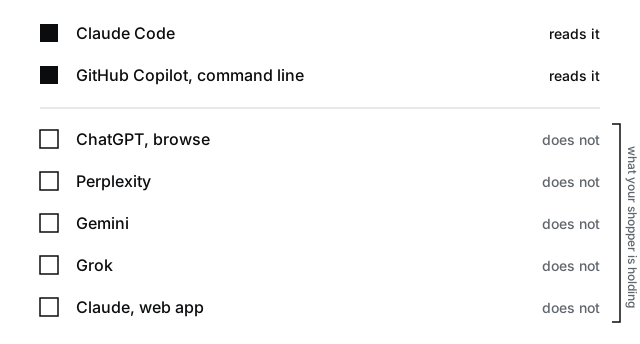
So it works, and it currently works for developer tools, not for the one engine your shopper is actually holding while they stand in the aisle or scroll before bed. Building for the header today is building for the reader who is not in the room yet.
Which leaves the boring fix, and the boring fix is the entire job. The engines quoting you read your HTML, so the facts have to sit in your HTML as text. Design alone leaves them unread.
The bet is small and it only runs one way. An afternoon of somebody's time, against an engine that will otherwise keep answering your buyers from whatever page was easiest to read, yours or somebody else's.
CPG AI Assessment
Fix the CPG workflow that keeps landing back on your desk.
I map the recurring reporting or operating workflow first, then build only when the first useful fix is clear.