By Smári Ásmundsson · · 6 min read
Best AI Search Optimization Software for Precise Data: Grade It First
What is the best AI search optimization software for precise data, and what should a CPG brand check first?
A software vendor emails to say AI assistants are recommending your competitors and not you, and attaches a dashboard with a score of 43 out of 100 to prove it. You have no way to tell what the 43 is made of. There is no single best AI search optimization software for precise data, and anyone who names one without seeing your products is guessing. The precise one is the tool that shows you every answer it measured, so you can repeat the check yourself before you pay.
Where does a tool's AI search data come from?
This software watches what AI assistants say about your brand. An AI assistant is a chat tool such as ChatGPT or Claude. People now type a question into one, such as which plant protein has no sweeteners, instead of searching. The software's job is to tell you what those tools answer when your product comes up.
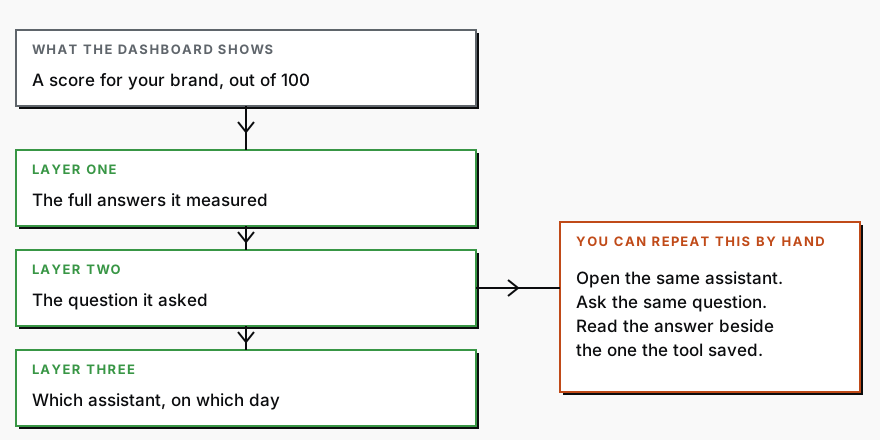
There are two ways a tool can know what an AI assistant says about your brand. It can ask the assistant and save the answer, or it can estimate. Only the first leaves something you can read.
So the first question for any tool is what it asked, which assistant it asked, and on what day. A tool that measured something can show you the exact question, the assistant's full reply and the date. A tool that only shows a score has hidden all three. That does not make the score wrong. It means you cannot tell.
How can a brand repeat a tool's check itself?
Take one question from the tool's report. Open the same assistant in your browser, which for ChatGPT or Claude is a web page with a box to type in, and type the question exactly as the tool wrote it. Read your answer beside the one the tool saved.
Expect the wording to differ. Ask any assistant the same question twice and the sentences change. What should match is the substance: which brands come up, and which facts about your product are stated. If your answer names your brand and the tool's saved answer does not, or the reverse, ask the seller why. A tool that shows you one reply as though it were the answer is selling more precision than it has.
What does the tool change on the product page?
Ask the seller to name one change the tool makes to your site, or tells you to make. A useful answer is specific: the ingredient list is now text and not a photograph, the sizes and prices are written as plain text a search engine or a chat tool can read, the barcode is on the page.
Your product page has two readers shows the first of those failures, and what your website tells machines shows the second. If a tool only reports and changes nothing on the page, it is a thermometer. That can still be worth a small monthly fee. It is not worth a large one, because the reading does not fix anything.
When is no tool needed yet?
If you sell a handful of products and the facts on your pages are already plain text, the check costs you nothing to run by hand. Ask three assistants the questions a buyer would ask about your product once a month, and keep the answers in one file.
If a retailer's buyers are starting to ask chat tools about products like yours, your next big buyer may be a shopping helper and the fix starts with your listing and not with a subscription. A tool earns its fee when you have enough products, in enough places, that nobody on your team can ask the questions by hand.
Grade the tool before you pay for it
In the older days you would sit through the demo, ask the seller whatever came to mind, request a trial, and compare two or three vendors in a spreadsheet. That is an afternoon of calls and a week of waiting on trial access, and you would still be comparing sales pages.
Today, whoever sat through the demo pastes their notes, or the tool's sales page, into Claude, the AI chat assistant from Anthropic, and you have a verdict in about a minute. Claude opens in a browser at claude.ai, and ChatGPT works the same way if your team already uses it. Here is what comes back, for a made-up tool:
| Question | Result | What it found in the paste |
|---|---|---|
| Where does the data come from? | Partial | Says it "queries leading assistants daily" and does not name which ones. |
| Does it show the full answers? | Not shown | Only a score and a trend line. |
| Can a person repeat one check by hand? | Not shown | No question text anywhere. |
| What does it change on my product pages? | Pass | Lists the ingredient panel as text and the barcode on the page. |
Verdict: SKIP. Only one of four passes. It ends with three questions to put to the seller on the next call, starting with "which assistants, and can I see one saved answer?"
This is the grading you paste in, with the tool's page or your demo notes underneath it:
Below is the sales page, demo notes or sample report for one tool that says it measures how AI shopping assistants and chat assistants talk about a food or drink brand. Grade it on four questions using only what I paste. Do not use anything you know about the tool from outside.

1. Where does its data come from? Does it name the assistants it asked, the questions it asked and the date?
2. Does it show the full answers it measured, or only a score?
3. Could a person repeat one of its checks by hand in ten minutes? Say how.
4. What does it change on my product pages, if anything? Name the change.

For each question give PASS, PARTIAL or NOT SHOWN, with the sentence from my paste that supports it. If my paste does not say, write NOT SHOWN. Do not guess.

Then give one verdict. BUY if all four pass. TEST if two or three pass, and name the one thing I should ask for in a trial. SKIP if fewer than two pass. Finish with three questions to ask the seller on the next call.

[paste the tool's page, your demo notes or its sample report underneath this line]
The person who sat in the demo does the pasting, and a few minutes of that is the whole job. Your part is reading the verdict and deciding whether the seller's answers to the three questions are good enough to go on.
When you would rather have this done against your own product pages than a vendor's brochure, the CPG AI Assessment takes one job of yours apart and returns a written scope, a price to build it and the hours it gives back.
CPG AI Assessment
Fix the CPG workflow that keeps landing back on your desk.
I map the recurring reporting or operating workflow first, then build only when the first useful fix is clear.