By Smári Ásmundsson · · 6 min read
Brand visibility in AI search: how a CPG brand checks it and what moves it
How does a CPG brand check its brand visibility in AI search, and what changes it?
A buyer asks an AI assistant which protein bar to try, which hot sauce a restaurant should stock, or which cracker a grocery buyer should add to the shelf. The answer names three brands. Yours is one of them or it is not, and no report tells you which. The question gets asked whether you sell direct or through distributors and retailers, by your buyer or by your buyer's customer.
Brand visibility in AI search is whether those answers name your brand, which of your pages they cite, and who they name instead. You can measure all three in one sitting without a tool subscription.
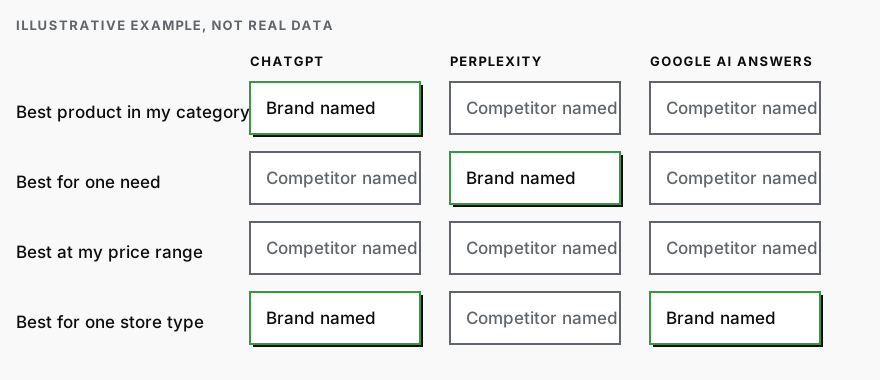
How do you see whether AI answers name your brand for the questions buyers ask?
In the older days you would open three AI answer tools in three tabs: ChatGPT, Perplexity (another AI answer tool) and the AI summary Google now puts above some search results. You would type your buyer's questions into each, copy every answer into a spreadsheet, read the list of sources under it, and mark by hand whether your brand appeared, which page was cited and who got named instead. Six questions across three assistants is eighteen answers. Done properly, that is most of an afternoon. It happens once and nobody repeats it.
Today Claude, an AI chat assistant like ChatGPT, does the reading and the scoring. The only part left for a person is running the questions, which is typing and pasting, because each assistant only answers for itself. Nobody needs to understand AI to do it well.
- Open a new Claude chat. Give it your brand name and website, your category and your three closest competitors, and ask it to write six questions a buyer would type into an AI assistant when choosing a product in your category: two broad ones such as "what is the best ... ", two about a need such as an ingredient, a diet, a price range or a type of store, and two about your brand by name, each under 25 words.
- Anyone on your team runs all six in ChatGPT, in Perplexity and in a Google search that shows the AI summary. Each answer lists the sources it drew on, and a cited page is a page it lists. Paste every answer and its sources into one document, labelled with the assistant and the question number.
- Go back to the same Claude chat and paste in the document, with the instructions further down.
The scorecard comes back as a table. This is what it looks like, with invented answers. The first six rows of eighteen.
| Question | Assistant | Brand named | Your page cited | Named instead | Phrase from your page |
|---|---|---|---|---|---|
| 1 | ChatGPT | no | none | Competitor A | none |
| 1 | Perplexity | yes | yourbrand.com/products/original | none | "no added sugar" |
| 1 | Google summary | no | sources not shown | Competitor A | none |
| 2 | ChatGPT | no | none | Competitor B | none |
| 2 | Perplexity | no | none | Competitor A, Competitor B | none |
| 2 | Google summary | no | sources not shown | Competitor B | none |
Under the table Claude adds a summary: your brand was named in 7 of 18 answers, Competitor A was named most often, and questions 2 and 5 name you nowhere.
A prompt is the instruction you type into the chat box. For step 3, paste this one as it is, followed by the document.
Below are answers from three AI assistants to the six buyer questions. The brand to check is the one I named earlier in this chat. Build a table with one row per assistant per question and these columns: question number, assistant, was my brand named (yes or no), which of my own pages were cited (full address, or "none"), which competitor was named instead of me, and the phrase in the answer that seems to come from my own pages. If an answer shows no sources, write "sources not shown" and do not guess. Under the table, tell me how many answers named my brand out of the total, which competitors were named most often, and which questions named me nowhere. Do not state anything that is not in the pasted text.The brand-by-name questions will often name you, because the question hands the assistant your name. The others are the real reading, and a missing brand there is the finding, not a failure of the test.
Which pages do AI answers cite, and why yours or a competitor's?
The cited-pages column shows where each answer came from. I cannot tell you how any one assistant weighs its sources, and nobody outside those companies can. The scorecard gives you something better: what each assistant cited for your questions, this month.
Start with the rows for the questions that do not name your brand. A "no" there, with a competitor named, is the row to read first. Three patterns show up, and each points at a different fix.
If a competitor is named and the cited page is a retailer listing or a comparison article, the answer leans on that page and not on your site. The fix is the listing. A blank field on a wholesale item-setup form is read by shopping assistants too, so send the retailer corrected data.
If your brand is named but none of your pages is cited, the assistant knows you from somewhere else. Your own product page is not doing the work yet.
If your page is cited, read the quoted phrase. That is the sentence an assistant lifted. If it is wrong or vague, you know which line to rewrite.
What on a product page changes what AI says about the brand?
The scorecard names the line. Fixing it follows the same logic each time: say the fact in plain words, in text, where a machine reads it. A shopper can ask an assistant whether your product contains an ingredient they avoid, and the answer comes from whichever page states it clearly. A claim that lives only in a photo of the label gives the assistant nothing to quote.
Behind every product page sits a layer of labels shoppers never see: the product name, price and ingredients, written for search engines and AI tools to read. I wrote up what an AI assistant found when I had it read that layer on my own product page. Ask Claude to do the same read on your page and compare it with the phrases the scorecard quoted.
One case where this does not hold: a small category with few pages written about it. If the sources are all retailers and review sites, your own page may never be cited however well it reads, and the move is the listing, not the page.
How often should a brand rerun the check?
Monthly, using the same six questions, so each month's rows line up with the last. Rerun it as well after any change to a product page or a retailer listing, because that is the only way to see whether the change moved an answer. The same question can return a different answer on a different day, so one check is a snapshot and three in a row is a trend. It also keeps you honest about your own fixes. A listing you corrected in October should show up as a changed row in November. If it does not, that answer may not rely on the listing, and you have saved yourself from fixing the next ten the same way.
Keep the question set in the Claude chat or a note. Next month, paste the new answers into the same chat and add one line: "Compare this with the earlier scorecard and tell me which rows changed."
CPG AI Assessment
Fix the CPG workflow that keeps landing back on your desk.
I map the recurring reporting or operating workflow first, then build only when the first useful fix is clear.