By Smári Ásmundsson · · 3 min read
Confident is worse than wrong
The wrong answers you catch are the ones that sound made up. The one that costs you sounds exactly right.
You know which broker actually pays on time, why you never discount before Q4, what the last formulation change actually did to shelf life, which co-manufacturer cuts corners on lot codes. None of that lives in a system. It lives in you, and in whoever has been doing the job long enough to have been burned by it once.
Fifteen years of that kind of knowledge is the reason you can answer, in a sentence, a question that took someone else three years to learn the hard way. None of it is written down anywhere, because it never had to be. You were always in the room.
Why is confident worse than wrong?
Hand that business to an AI helper without writing any of it down first, and confident is worse than wrong. Not a bland marketing email. A reorder recommendation that has never heard of your actual payment terms. A cut-this-SKU argument that knows nothing about the retailer relationship behind it. The AI isn't wrong because it made something up. It's wrong because it reasoned cleanly from a version of your business missing everything you never wrote down, and a clean, confident, well-reasoned wrong answer is harder to catch than an invented one. You expect the made-up answer to look strange. The one built on a true-sounding gap in what it knows looks exactly like the right one.
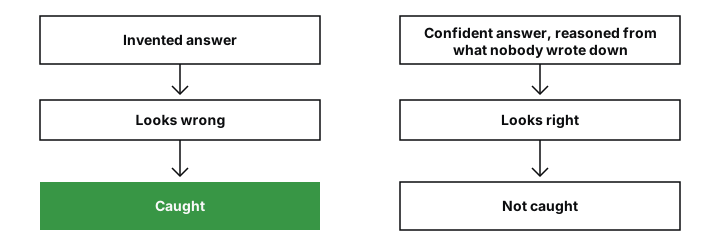
Ask it whether to cut a slow-moving SKU and it will reason from margin and velocity, both real numbers, and conclude cut. It has no way to know that SKU is why your biggest account started buying from you in the first place. Nobody wrote that down anywhere, because it lived in your head and in the buyer's, not in a spreadsheet. The AI never sees the version of your business where that relationship exists, so it never gets the chance to be wrong about it. It just never knew.
How do you write it down so an AI can use it?
So write it down, with a structure, not a folder.
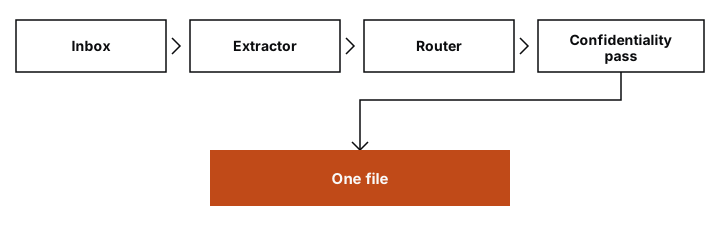
An inbox for the raw material: the supplier email, the call where a co-man walked you through a spec change, the actual reason a customer complaint got resolved the way it did.
An extractor that pulls out the judgment, not the event. Not "we had a supply issue in March." The decision underneath it: why you ate the cost instead of passing it to the retailer, and what you would do differently at twice the volume. The event is a fact anyone could look up. The judgment is the only thing worth capturing, because it's the only part an AI can't reconstruct from a database.
A router that sorts by the parts of the business that actually differ from each other: retail terms, formulation, supply chain, cash. A discount decision and a shelf-life decision are not the same kind of judgment wearing different clothes; they come from different pressures and get built by different people, so lumping them into one pile just to have one pile defeats the point of having one.
A confidentiality pass. What gets stripped is never the judgment. It is the one number that would tell a competitor exactly what you pay.
What comes out
What comes out is one file an AI can actually reason from, instead of starting cold every time you ask it something. It can only work with what actually reaches it, and everything still sitting in your head reaches nothing.
The file also does not reset. Every decision you add to it is one the next question doesn't have to start cold on, which is the opposite of how this usually goes: most systems get slower as they get bigger, and this one gets more useful the longer you keep feeding it, because the thing accumulating is judgment, not overhead.
Where to start
The version of this that would help you fastest is not a system. It is a Friday afternoon and a blank document: five decisions from this month you made on judgment nobody could have looked up, written down in your own words. That is the raw material. The structure comes after you have something to structure.
CPG AI Assessment
Fix the CPG workflow that keeps landing back on your desk.
I map the recurring reporting or operating workflow first, then build only when the first useful fix is clear.