By Smári Ásmundsson · · 4 min read
You ranked it by how much you hate it
The work you hate and the work worth automating are two different lists. Here is the question that re-sorts them.
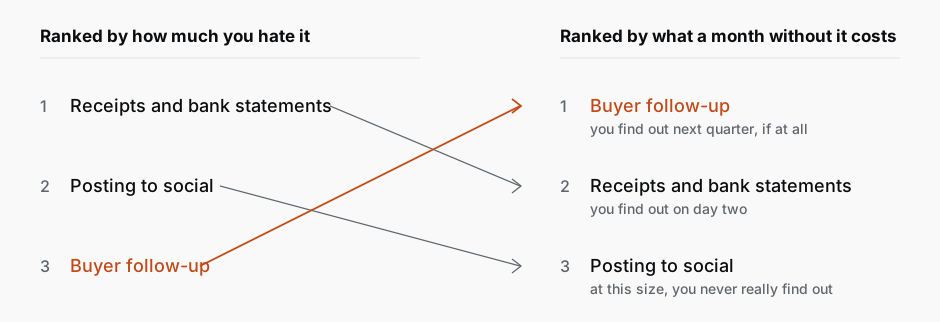
Every founder I talk to has the list. It is rarely written down, but it comes out in the first ten minutes: the work they would hand to a machine tomorrow. Receipts and bank statements. Posting to social. Chasing the buyer who has not reordered.
The list arrives in the same order almost every time. That order is how much they hate doing it.
Then they ask which one to build first. The list is sorted by the wrong key.
Ask what a month of silence costs
Take each item and ask one question about it. If nobody does this for a month, what happens?
Nobody scans a receipt for a month and your bookkeeper gets irritated, the close slips a week, and you lose a Saturday in January putting it right. That cost is real and you know it the day it lands. It does not compound.
Nobody posts for a month and, at your size, very little happens that you can measure. Nobody unfollows a snack brand for going quiet in July, and the effect on the quarter sits inside the noise of everything else you did.
Nobody follows up with a buyer for a month and an account you already won reorders late, or stops. You find out in next quarter's numbers, and by then you cannot separate a lost account from a soft category. You will probably blame the category, because that is the story the numbers tell when nobody was watching the account.
That third one is at the bottom of every list of hated work. It does not feel like work. Nothing overflows, no one chases you, and the day it goes undone looks exactly like the day it gets done. It is also the only one of the three that costs you money.
The rule that falls out of it
Rank the work by how long it takes to notice it did not happen, multiplied by what it was worth.
Work whose absence shows up by Friday does not need a system. You already have one, and it is the discomfort. Work whose absence is invisible for ninety days is the work to build around, because a system is the only thing that notices on day one.
That is the whole re-sort. Your list is ordered by which work interrupts you. The useful one is ordered by how long you would go without knowing.
Why finance keeps winning a race it should lose
Finance sits at the top of most founders' lists, and it is loud, immediate and self-reporting. You always know when the books are behind, because someone tells you. Under this test it scores low for exactly the reason it feels urgent: you find out on day two.
Finance is also unforgiving of a system that is still learning. You want to find out what your first build gets wrong before it is wrong about money.
What this work looks like when a system holds it
I sat in two calls this month with brands doing serious revenue. One arrived already pointing at demand planning, which is the quiet one: millions of dollars of stock, and the wrong share of it in the wrong products. Invoicing came up on that call too, and it came up from me, because it is the loud one and the easiest to picture. The other wants every available gun pointed at paid acquisition, which is the thing that hurts most this quarter, while the accounts already won get whatever attention is left.
The second had ranked by irritation. The first had not, and that is the rarer thing: the person who raised it owns the number that demand planning moves, so the cost was already in front of him.
The build that follows from the other ranking is unglamorous. An account orders every six weeks. At week eight, something says so, in a place you will see, with the last three orders next to it. No agent negotiates, nothing sends without you, and there is no dashboard to remember to open. It notices, on the day, and it tells you.
That is a smaller build than the one on most founders' lists. It is also the one that has been costing them money since before they wrote the list.
Do this before you scope anything
Take your own list. Three items is enough. Beside each, write the date you would find out it had not been done, and what it was worth in the meantime.
The order will change. Build the one that moved to the top, and leave the receipts for later. They will still be there in January, and you will still know exactly what they cost.
CPG AI Assessment
Fix the CPG workflow that keeps landing back on your desk.
I map the recurring reporting or operating workflow first, then build only when the first useful fix is clear.