By Smári Ásmundsson · · 6 min read
Before you say yes to a promotion, work out how many units it has to sell
A retailer offers 15% off the shelf for four weeks. On illustrative numbers, your margin falls from $1.50 a unit to $0.81, and you need 186 units for every 100 you sell today.
A retailer offers 15% off your shelf price for four weeks. Before you say yes, work out how many units the promotion has to sell to pay for itself. It is four lines of arithmetic. On the made-up product below, that 15% discount eats 46% of your margin.
Here is the product, with illustrative numbers. You invoice the retailer $3.00 a unit and it costs you $1.50. The retailer takes 35% of the shelf price, so your $3.00 is the other 65%, and the shelf price is $4.62. Of that, $1.62 is the retailer's. Fifteen percent off $4.62 is 69 cents a unit.
Who pays those 69 cents is set by the deal in front of you. This calculation assumes the retailer keeps its $1.62 and the whole discount comes off your price. On the illustrative numbers, your margin falls from $1.50 a unit to 81 cents. If the retailer gives up part of its $1.62, you give up less, and every number below comes down.
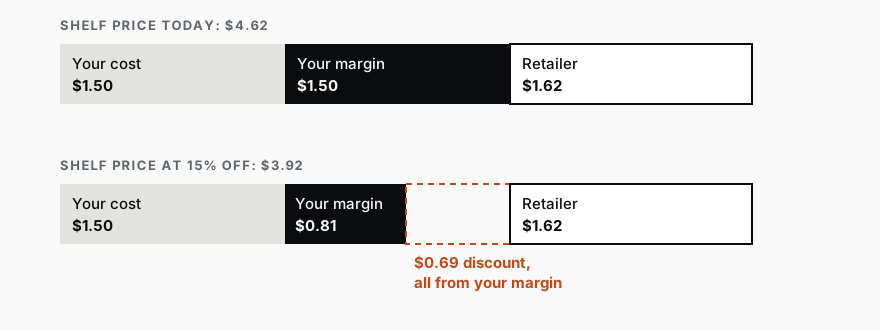
So 15% off the shelf costs you 69 cents of a $1.50 margin, which is 46% of it. At 81 cents a unit instead of $1.50, the made-up product has to sell more to earn the same dollars. For every 100 units it sells in a normal four weeks, the promotion has to sell 186. That is your break-even.
If you ship through KeHE, UNFI or another distributor, the shelf price starts from the distributor's price to the retailer. The distributor keeps its dollars during the promotion too, so the same promotion costs you more.
Say, on illustrative numbers, the distributor keeps 25% of what the retailer pays it. Your $3.00 becomes $4.00 to the retailer and $6.15 on the shelf. The same 15% off is then 92 cents a unit instead of 69, and the promotion needs 260 units for every 100 instead of 186.
The cost of depth is not a straight line
Run the same illustrative product through five depths and the shape shows up. Each unit count in the figure is rounded up to a whole unit.
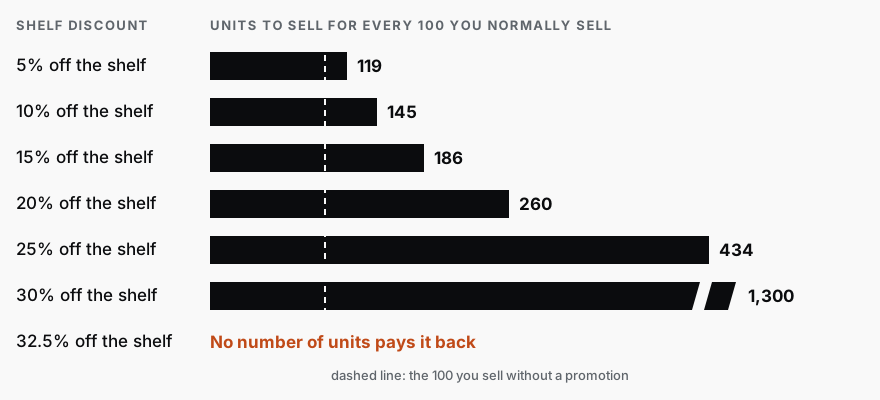
Every extra five points of discount costs more units than the last five did. On the made-up product, going from 5% to 10% adds 26 units per 100. Going from 20% to 25% adds 174. At 25% it needs 434 units for every 100, which asks the shelf to more than quadruple your volume. At 30% it earns 12 cents a unit and needs 1,300.
At 32.5% off it earns nothing on a unit, and no volume fixes that. That 32.5% is your ceiling: your margin divided by your shelf price, which on the illustrative numbers is $1.50 over $4.62. Work out your own before the call. Past it, every unit the promotion sells loses you money, whatever the buyer expects it to do for sales.
The curve also gives you a counteroffer. Say the buyer forecasts the made-up product at 160 units for every 100 at 15% off. It needs 186, so on the buyer's own forecast the promotion loses money. At 10% off it needs only 145, so ask what the buyer forecasts at 10%. If that number clears 145, you can say yes to the slot and offer 10%.
What the number does not tell you
The calculator uses no industry average for lift. Ask the buyer or your broker what lift they expect for this item at this depth and hold it against your break-even. If their forecast falls short of it, the promotion loses money on their numbers, and you have the counteroffer above.
Two costs sit outside the calculation, and both raise the number you need. One is any fee you pay to get the promotion on the shelf, and the other is the dip after it ends. On the made-up product, every $100 of fee takes another 124 units at 81 cents each to earn back.
A launch that needs shoppers to try it, or a shelf position you would lose without a promotion, can justify one that never reaches break-even. The shortfall below break-even is then the price of that trial or that slot. Compare it with what the same result would cost you another way.
The old way, and the way to do it now
In the older days, someone on your team built this in a spreadsheet. That spreadsheet had one row per item on the retailer's promotion sheet. Its columns were shelf price, discount in dollars, margin before, margin during and units needed. Twenty items is an afternoon.
Today, give the job to Claude and the whole sheet comes back in about a minute. Claude is an AI chat assistant like ChatGPT, and these instructions work in either. (A prompt is just the instructions you type in, and you can paste this one as it is.)
I sell packaged goods to retailers, directly or through a distributor. Below this message I will paste my price list and the retailer's promotion offer, as I have them. For every item on the offer, work out these five things:

1. The shelf price: what the retailer pays per unit divided by one minus the retailer's margin, where that margin is a percent of the shelf price. If I sell direct, the retailer pays my list price. If I sell through a distributor, the retailer pays the distributor's price, so use that. If I give you the shelf price, use it.
2. The discount in dollars per unit: the shelf price times the shelf discount they propose.
3. My margin per unit today: my list price minus my cost per unit.
4. My margin per unit on promotion: my list price minus the discount in dollars minus my cost.
5. The units I must sell during the promotion for every 100 I normally sell: 100 times my margin today divided by my margin on promotion.

Assume the retailer, and any distributor, keep the same dollars per unit during the promotion, so I pay the whole discount. If my margin on promotion is zero or less, write "no volume pays this back" and give the discount at which my margin reaches zero, which is my margin today divided by the shelf price. Do not estimate sales lift and do not use any industry average. If you need a number I did not give you, ask me before you start. Return one table with the items that cost me the most units first, and show your arithmetic for the first row.
Whoever keeps your price list can paste it under this, with the retailer's offer, and Claude does the whole sheet. The free calculator does one item at a time, for direct or distributor sales. Claude can misread a line of a pasted sheet, so put any item through the calculator before you quote its number to the buyer. Take the items marked "no volume pays this back" to the buyer first, with the ceiling Claude worked out for each one.
Services
The AI CPG WorkshopThe AI CPG Workshop: four live weeks with founder Smári Ásmundsson to build your company second brain, commercial workflows, dashboard and automation.
CPG AI Assessment
Fix the CPG workflow that keeps landing back on your desk.
I map the recurring reporting or operating workflow first, then build only when the first useful fix is clear.