By Smári Ásmundsson · · 5 min read
AI agents vs agentic AI: which a CPG brand needs
What is the difference between AI agents and agentic AI, and which does a CPG brand need?
A vendor tells you their product is agentic, and you cannot tell whether you are buying one helper or a whole chain of them. The two terms mostly describe the same thing from two sides. An AI agent is one piece of AI that does a job on its own, without you typing each step. Agentic AI is the name for a setup where AI takes several steps toward a goal, often with one agent's work feeding the next. A CPG brand needs the smaller one first: one agent, one job, and one named person who checks the result. A chain is worth building only when each handoff has a check, and some jobs need no agent yet.
Is agentic AI just a newer word for AI agents?
Close to it. The agent is the worker. Agentic describes how a setup behaves: it chooses its own next step rather than following a fixed list. Vendors use the word as a selling word, so ask what the job is, not what the product is called. If the answer is "it does everything", you have learned the product has no job description.
A fixed list of steps run in order is not the same thing as an agent that decides its own steps. The fixed list is more predictable. Prefer it when the job is the same every week, and keep the agent for work where the steps cannot be known in advance.
When is one agent enough?
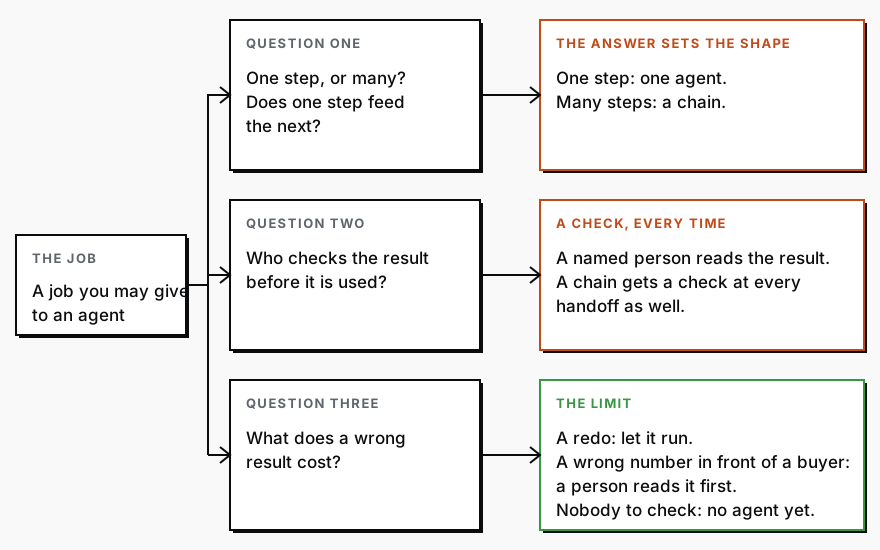
When the job is one step, or several steps that never depend on each other's result. Reading a weekly distributor file and writing the summary is one job. One agent does it, and one person reads the summary before it goes to the broker. Which AI agents should a small CPG brand use, and how should it choose? goes through that choice.
The test is whether the output of one step becomes the input of the next. If it does not, you do not need a chain, and adding one makes the setup costlier and harder to fix when it breaks.
What goes wrong when agents hand work to each other?
A wrong answer from the first agent becomes a fact for the second. The second agent has no way to know, so it builds on it and returns a clean, confident result. By the time you see it, the error is two steps deep and nothing marks where it started. A chain of agents makes mistakes compound, which is why every handoff gets its own check: the totals in step two equal the totals in the file from step one, for instance.
The check does not need to be clever. It has to be written down and run every time. A second AI can run it, and AI that audits the AI shows what that looks like.
What should a person still check?
Anything that leaves the building, and anything that moves money. A price change, a message to a customer, an order, a payment. A person looks at that result before it is used, and the job does not go live until you can name that person. If the honest answer is "nobody", the verdict is no agent yet. Treat AI like a hire covers the trial period before a job goes live.
Ask one more thing: what happens on a wrong result? If the cost is a redo this afternoon, the job can run. If the cost is a wrong number in front of a buyer, the person reads it first.
Test a job against the tree
In the older days you would draw the job out on a whiteboard, argue about the steps, then list how each step could fail and who would notice. That is a morning per job, and at the end you still have no clear answer.
Today, whoever owns the job pastes the instructions below into Claude, an AI chat assistant like ChatGPT, with a few sentences describing the job underneath. The answer takes a minute or two. Your part is reading it. This is what comes back for the example job "read the weekly distributor sales file and write the two paragraph summary the sales lead sends to the broker", with invented details:
| Question | Answer |
|---|---|
| One step or many? | One step. The summary uses the file and nothing else. |
| Who looks before it leaves? | The sales lead, before it goes to the broker. |
| What does a wrong result cost? | A wrong number in front of a broker. |
| Verdict | One agent |
| The check to add | The sales lead confirms the totals in the summary equal the totals in the file. |
I will describe a job I am thinking of handing to AI. Decide whether it needs one AI agent, a chain of agents where one's work feeds the next, or no agent yet. Answer three questions about the job, one sentence each. Is it one step or many, and does any step use the result of an earlier step? Who looks at the result before anyone outside the company or any money depends on it? If the result is wrong, who finds out, how soon, and what does it cost? Then give the verdict in capitals: ONE AGENT, A CHAIN, or NO AGENT YET. If a chain, name the check that goes between each pair of steps. If one agent, name the one check the person reviewing it should run. If no agent yet, say what has to be true first. Use plain words and explain any technical term where you use it. If my description does not say who reviews the result, say so and do not assume one.

The job:
If you want the job built and checked for you, the page for it is the Workflow Build.
Services
Workflow BuildYou stop doing the job that keeps coming back, and it stops being the thing that slips when the week gets busy. Those hours go back into the work that actually grows the brand.
CPG AI Assessment
Fix the CPG workflow that keeps landing back on your desk.
I map the recurring reporting or operating workflow first, then build only when the first useful fix is clear.