By Smári Ásmundsson · · 7 min read
AI sales agents for a CPG brand: retail buyer follow-up without the wrong send
How can a CPG brand use AI sales agents for retail buyer follow-up without sending the wrong thing?
A buyer asks for a case pack and a price sheet, you say you will send both by Friday, and eleven days later the thread is still waiting on you. The buyer has not complained. The buyer has just stopped waiting.
AI can catch that. It reads your email thread with a retail buyer and your notes on the deal, works out whether a reply is owed, and writes the draft. Before the draft reaches you, it checks it against four tests: right buyer, right product, no promise of terms, nothing invented. It never sends anything. You read what passed and send it yourself.
What should an AI sales agent do without asking?
An AI sales agent here is an AI assistant with one narrow job: read buyer emails and draft the next reply. Without asking you, it can do five things, and none of them sends anything.
- Read the thread and your notes.
- Decide whether a follow-up is due.
- Write a short draft.
- Run the four checks on its own draft.
- Put the result in front of you.
Those five steps are all it needs. Nothing reaches a buyer until you press send, so the worst a bad draft can do is waste a minute of your time.
What must it never send on its own?
Everything waits for you. The first version sends nothing at all. A buyer treats an email as a commitment, and an AI writes fluent sentences whether or not you meant them. "We can hold that price through the spring reset" reads like a promise because it is one, and a buyer can quote it back to you.
Whoever reads the draft, you or the person who manages your retail accounts, should watch for four kinds of wrong send:
- A reply to the wrong buyer, or one that names the wrong retailer.
- A product, size or pack count the buyer did not ask about.
- A price, discount, promotion funding, payment term, delivery date or minimum order you have not agreed to.
- A date, number or claim that is in neither the thread nor your notes.
Those four are the checklist. Each one is a pass or a fail, and each pass has to quote the line that proves it.
How does it know which buyer is due a follow-up?
You give it three rules. A follow-up is due when the last message in the thread is yours and is more than seven days old with no reply. It is due when the buyer asked a question nobody answered. And it is due when your notes name a date that has passed, such as samples promised by the 12th.
The AI has to quote the line from the thread or the notes that makes it due. If it cannot quote a line, the answer is no. That one rule stops an AI from inventing a reason to write to someone. You also type today's date at the top, because an AI does not reliably know it.
What does it hand back?
For one buyer, this is what comes back. Every detail is illustrative.
- Follow-up due: yes. Your note of 3 March says "case pack and price sheet by 7 March". Nothing was sent after it.
- Draft: "Thanks for your patience. The case pack and price sheet are attached. The pack is 12 to a case, as you asked. Tell me if the retailer needs anything else for the review."
- Right buyer: pass. The greeting and retailer match the last message in the thread.
- Right product: pass. The 12-count appears in the buyer's second message.
- No promise of terms: fail. The first draft said "ready to ship in two weeks", which is a delivery date you never agreed to. The line was cut.
- Nothing invented: fail, for the same line. Neither the thread nor your notes mention two weeks. The draft was rewritten and both tests now pass.
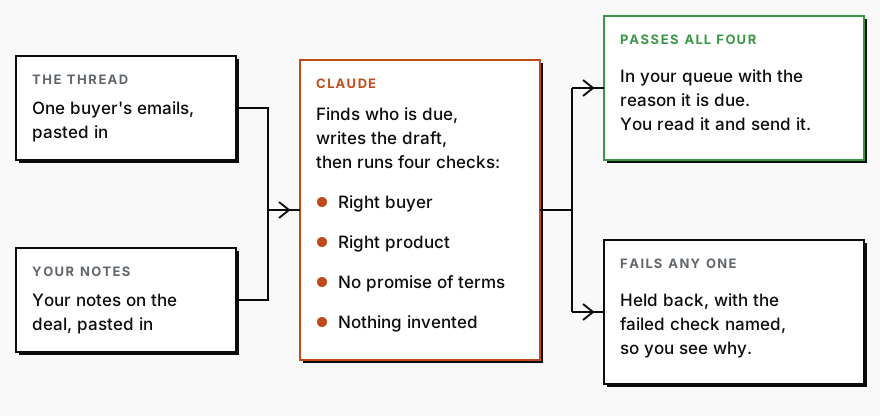
The failed check is the useful part. A draft that fails and is repaired before you see it is a draft you did not have to catch.
How do you check its drafts before they go out?
Two layers. The first is the four checks, which the AI runs on its own draft and shows you. The second is you, reading what passed.
Be honest about what the first layer is. The AI is checking its own draft against the same thread, so it is a second look, not a second opinion. It catches the wrong product, the wrong buyer and the invented date. It cannot catch a promise you made on a phone call that is in neither the thread nor your notes. That is why you still read every draft, and why the draft stays a draft.
The habit that makes this safe is the one in Treat AI like a hire, not a tool: new work is read until it has earned less reading. Why the check should be a separate step from the writing is in The AI that audits the AI. And what keeps the checks honest months later is the review step in this note on keeping automated AI work accurate after it goes live.
If you would rather not paste a thread each time, Workflow Build is our setup of the same reading, drafting and checking, so it runs without you.
Turn a buyer thread into a checked follow-up
In the older days you would open each buyer's thread, scroll back to find what you promised, check your deal notes for what was agreed, write the reply, and read it again to make sure it did not commit you to a price. For a brand with fifteen active retail buyers, call it about three hours a week, an illustrative figure. And three hours later you have drafts, and a quiet worry that one of them says more than you meant.
Today, give this to Claude, an AI assistant you can type to like a colleague, and you have the answer for one buyer in about a minute. (A prompt is just the instructions you type in; you can paste this one as it is.) Type today's date on the first line under it, then paste the buyer's email thread, then your notes on the deal. Whoever manages your retail accounts can do this in the same minute, so the part that is yours is reading the draft. Next week, paste the new thread into the same chat.
You help the founder of a small food and beverage brand keep up with retail buyers. Use plain English.

Below these instructions are three things: today's date, an email thread with one retail buyer, and my notes on that deal. Read all three, then do these jobs in order.

1. Is a follow-up due? It is due if the last message in the thread is from the founder and has had no reply for more than seven days, or if the buyer asked a question nobody answered, or if the deal notes name a date that has passed. Answer yes or no, and quote the exact line from the thread or notes that makes it due. If you cannot quote a line, answer no and stop.

2. If it is due, write a short reply from me to the buyer who wrote the last message. Three to five sentences, plain, no hype. Answer only what the buyer asked. Offer nothing they did not ask for.

3. Check your draft against these four tests. For each one write PASS or FAIL and quote the line that proves it.
- Right buyer: the greeting and the retailer name match the buyer in the thread.
- Right product: every product, size and pack count in the draft appears in the thread or my notes.
- No promise of terms: the draft states or hints at no price, discount, promotion funding, payment term, delivery date or minimum order, unless my notes say I already agreed to it.
- Nothing invented: every date, number and claim in the draft appears in the thread or my notes.

4. If any test fails, rewrite the draft to fix it and run the four tests again. If a test still fails, say so and do not offer a draft.

Show me, in this order: due or not due with the quoted line, the draft, and the four results. Never send anything. Never fill in a fact that is missing. If something is missing, say what is missing.Services
Workflow BuildYou stop doing the job that keeps coming back, and it stops being the thing that slips when the week gets busy. Those hours go back into the work that actually grows the brand.
CPG AI Assessment
Fix the CPG workflow that keeps landing back on your desk.
I map the recurring reporting or operating workflow first, then build only when the first useful fix is clear.