By Smári Ásmundsson · · 6 min read
AI marketing agents: what a CPG brand can hand over and what a person keeps
What can AI marketing agents do for a CPG brand, and what should you keep a person on?
It is Thursday night. Saturday's email is not written, the ad needs four new versions, and the weekly sales summary is still a pile of spreadsheets pulled from your systems. AI can write that email, those four versions and a first pass of that summary without you in the room. What it should not do alone is send a price, make a new claim about your product, or speak to a retailer for you. A person approves those. Everything else gets checked against a written rule first, and the tree below shows which task lands where.
Which marketing tasks can an AI marketing agent finish without a person?
An AI marketing agent is an AI that does a marketing task for you, working through the steps on its own without you typing each one. The tasks it can finish alone are the ones where a mistake costs a redo, not a customer. A weekly sales report that only you read is one. A list of caption ideas you will rewrite yourself is another. "Finish" means finish the draft. It does not mean press send.
Walk each task through three questions, in order, and stop at the first answer.
- Does it leave the building or spend money? If no, the agent finishes it alone. If yes, go on.
- Does it name a price, make a new claim, or promise a term? A discount, a health or "free from" claim you have not already approved, a delivery date to a retailer. If yes, a person decides. If no, go on.
- Can a written rule catch the mistake? A list of banned words, a list of approved claims, a price list to match against. If yes, the agent works with a named check, which is that rule applied to every draft before you see it. If no, a person decides.
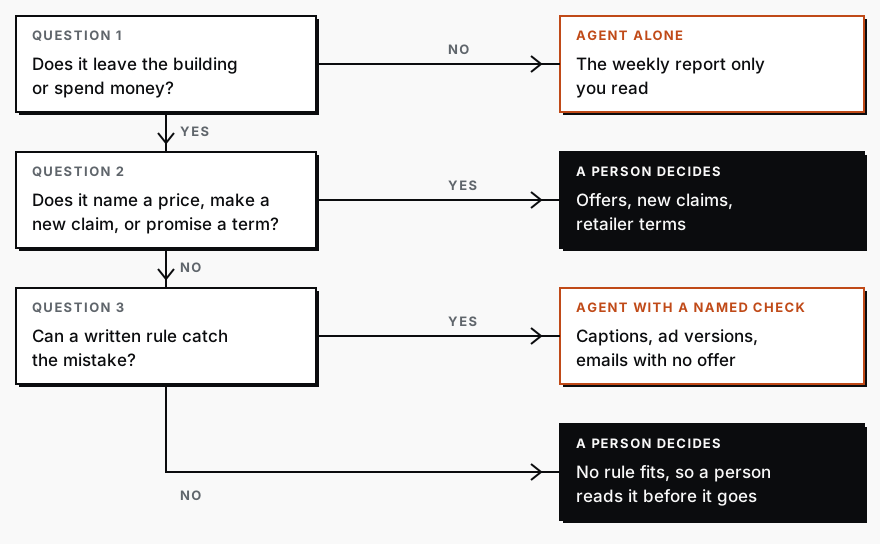
Here is how five weekly tasks fall out. Treat the answers as an example. Your brand may sort them differently, because the questions carry the decision, not the table.
| Task | Where it lands | What sent it there |
|---|---|---|
| Weekly sales report | Agent alone | Question 1: only you read it |
| Social captions | Agent with a named check | Question 3: a banned-words and approved-claims list catches the mistake |
| Ad versions | Agent with a named check | Question 3: each version may only use claims already on your approved list |
| Email with a discount in it | A person decides | Question 2: it names a price |
| Product page copy | A person decides | Question 2: it states ingredients and servings, and a wrong fact is a claim |
What check catches an agent that writes off-brand copy?
A second read of each finished draft, by the AI, against your rules and nothing else. Give it three things: the words you never use, the claims you never make, and three pieces of copy you would approve as they stand. For each draft it says pass or fail, with the exact line that broke a rule. I wrote about why this works in The AI that audits the AI: a standard applied the same way every time catches what a tired person skims past.
It will not catch copy that follows every rule and still sounds like nobody. For that, add three pieces you rejected and one line on why. And a person should read one piece a week, because a check nobody ever reads goes stale.
What should never go out without a person approving it?
Six things, and the list is short on purpose.
- Any price, discount or promotion.
- Any health, nutrition or "free from" claim.
- Anything addressed to a retailer buyer, broker or distributor about terms.
- A reply to a complaint or a bad review.
- Anything about an allergen, a recall or a safety question.
- Anything that goes to the press.
The cost of being wrong on these is not a redo. It is a retailer, a customer or a regulator reading it. A new hire can draft every one of them and a manager signs each. I wrote about running AI the same way in Treat AI like a hire, not a tool.
How do you tell an agent from a scheduled prompt (instructions that run on a timer)?
A prompt is the set of instructions you type into an AI. A scheduled prompt runs the same instructions on the same day each week without anyone typing, gives one answer and stops. An agent decides its own next step. It opens the report, sees a missing column, goes to the second file to find it, tries again and tells you what it did.
To tell them apart, take one file away and watch. An agent goes looking for it. A scheduled prompt carries on without it.
For most weekly marketing work, a prompt with a check is enough. Reach for an agent when the task has steps that depend on what it finds. Which AI agents should a small CPG brand use, and how should it choose? walks through that choice.
Set it up once, then read only what needs you
In the older days, the week's marketing started with whoever owns it opening five tabs: last week's email, the ad account, the caption calendar, the product page and the sales export. They drafted five pieces, re-read each one against the brand rules and the approved claims, then wrote the founder a note on which ones needed a decision. Say four hours for a week like this one. That is an illustration, not a measurement.
Today, the same person gives the instructions below to Claude, an AI chat assistant, and the sorted week comes back in minutes. Here is an example of what comes back, for a week like the one above:
| Piece | Group | Why |
|---|---|---|
| Weekly sales report | Finished | Built only from the export that was pasted, with the totals it used shown beside it |
| Three social captions | Checked, passed | No banned words, no claims |
| Four ad versions | Checked, one failed | Version 3 says "clinically proven", which is not on the approved claims list |
| Saturday email | Needs a person | It names a discount |
| Product page copy | Needs a person | It changes the serving size line |
Your part is the last two rows and the one failed version. Whoever owns marketing on your team pastes the instructions each week, with three things underneath: your brand rules, your approved claims, and this week's notes with last week's sales export (the spreadsheet your sales system gives you). You read the "Needs a person" group, and nothing else.
You are drafting this week's marketing for a consumer food brand. Under this message are our brand rules, our approved claims, and this week's notes with last week's sales export.

Draft one email, four ad versions, three social captions, any product page copy that has to change, and a one-page report on last week's sales.

Then put every piece in one of three groups, with one line on why:
1. Finished: it never leaves the company, so only we read it.
2. Checked: re-read it against the brand rules and approved claims. Say pass or fail, and quote the exact line that failed.
3. Needs a person: it names a price or discount, makes a health, nutrition or "free from" claim that is not on the approved list, speaks to a retailer, replies to a complaint, or changes a fact on the product page.

When unsure, choose Needs a person. Use only the numbers I pasted. If something is missing, list what is missing instead of guessing.
Next week, paste the new notes and export into the same chat.
That is a prompt with a check, run by hand each week, which is where I would start. When you want it to pull the files itself and run each week with nobody pasting, that is the work we do in Workflow Build.
Services
Workflow BuildYou stop doing the job that keeps coming back, and it stops being the thing that slips when the week gets busy. Those hours go back into the work that actually grows the brand.
CPG AI Assessment
Fix the CPG workflow that keeps landing back on your desk.
I map the recurring reporting or operating workflow first, then build only when the first useful fix is clear.