By Smári Ásmundsson · · 4 min read
AI strategy consultant: what a CPG founder should hold at the end
What should an AI strategy consultant leave a seven-figure CPG founder with at the end of the first engagement?
A consultant's proposal lands in your inbox with eleven pages, a timeline and a fee. You cannot tell whether you are paying for decisions or for a deck. The first engagement with an AI strategy consultant should leave a seven-figure CPG founder holding four things in writing. The first is a ranked list of the tasks AI will take over. The second is a named owner for each task. The third is one first build, with a test that says whether it passed. The fourth is a rule for when to stop spending. If the proposal does not promise all four, you are buying slides.
What is a strategy deliverable versus a slide deck?
A deck describes. A deliverable assigns. The test is whether someone on your team could start on it tomorrow without a call with the consultant. Four terms matter below. A task here is a piece of work, like the weekly sales summary, and never a person. A first build is the first task actually set up and running. A pass test is one sentence saying what done looks like. A stop rule is the point at which you stop paying if the pass test fails.
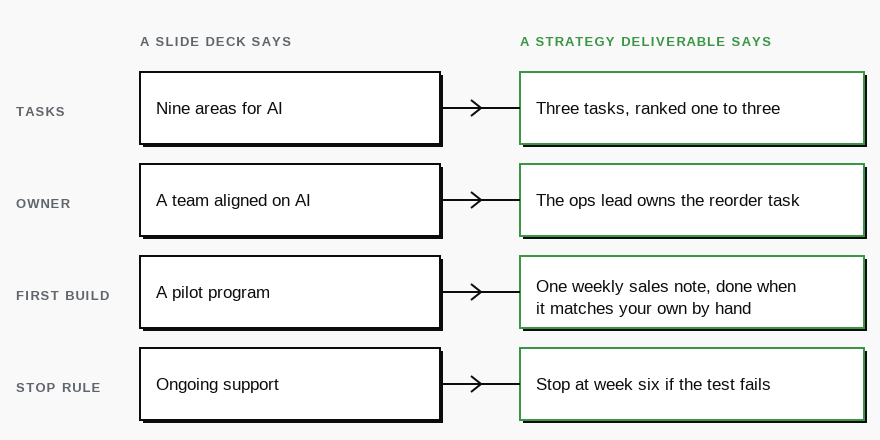
Each of the four pieces answers a question you will otherwise be asked by your own team in the first week. Which task comes first? Who runs it? How will we know it worked? When do we quit? A deck answers none of them, and the next invoice pays for the answers.
How does a founder tell strategy from sales?
Strategy cuts. Sales adds. A proposal that ranks twelve areas and drops none of them is a menu, and a menu is how a consultant keeps every option billable. Read for three tells:
- Nothing is ranked, so every area gets the same slide.
- The owners are all the consultant's people. Someone on your side has to hold each task, or it stops the day the engagement ends.
- The first build is a product the consultant sells, rather than the task that costs you the most time.
A fourth tell is what is missing, and missing items are the hardest thing to see when you read a proposal front to back. You read what is on the page. A stop rule is never on the page.
What should be built in the first month?
One task, built end to end, with a pass test written before the work starts. What an AI implementation consultant does for a CPG brand in the first month walks through that month. The five jobs AI does in a CPG brand, and where to start is the list the first build should come from. A good pass test is one sentence: for example, the weekly sales summary matches the numbers your team produced by hand, four weeks in a row.
Have AI score the proposal against the four
Until now you would print the proposal, read eleven pages with a highlighter and write your questions in the margin. That is an evening, and it still misses what the proposal left out.
Today whoever handles your proposals pastes the instructions below into Claude, Anthropic's AI assistant, which you type to like a chat. They put the proposal underneath and the answer comes back while you finish your coffee. Your part is to read the three questions at the bottom and ask them before you sign. Here is what comes back for an example proposal:
- Ranked task list: Missing. The line "Phase one covers nine areas across the business" gives no order.
- Named owner per task: Partly. Three of the nine name a person, and none of them works for you.
- First build with a pass test: Missing. The line "a pilot in month two" has no definition of done.
- Stop rule: Missing. The line "fees are monthly for six months" runs whatever happens.
- Question one: which of the nine areas do you build first?
- Question two: who on my team owns each task after you leave?
- Question three: what result in month two would make us stop?
And here are the instructions to paste:
I am the founder of a consumer goods brand and I am about to sign a consultant's proposal, pasted below. Check it against four things a first engagement must leave me holding in writing: (1) a ranked list of the tasks AI will take over in my business, with the order explained; (2) a named owner for each task, who works for me and not for the consultant; (3) one first build, with a pass test that says in one sentence what done looks like; (4) a stop rule, the point at which we stop spending if the build does not pass. For each, answer Present, Partly or Missing, quote the line in the proposal that supports your answer, and say in one sentence what is absent. Then give me the three questions to ask the consultant before I sign, most important first. Do not rewrite the proposal and do not praise it.If you want a second opinion on the proposal before you sign, the CPG AI Assessment is how we start with a brand. The scorecard above works without us, on any proposal, ours included.
CPG AI Assessment
Fix the CPG workflow that keeps landing back on your desk.
I map the recurring reporting or operating workflow first, then build only when the first useful fix is clear.