By Smári Ásmundsson · · 6 min read
AI consultant for small business: does a seven-figure CPG brand need one, a workshop, or neither?
Does a seven-figure CPG brand need an ai consultant for small business, a workshop, or neither?
A proposal arrives for AI help, with one price at the bottom and no way to tell what you would own in six months. The same week, someone tells you a workshop is all you need. For a seven-figure CPG brand the answer depends on four facts about the one job you want help with. Does it recur? Does a person on your team own it? Does its information sit in one place? Does its result reach a retailer or a customer? You can have AI score your job against those four in about a minute and name the next step.
What are the four questions, and where do they lead?
The figure shows the order. Each question can end the search early.
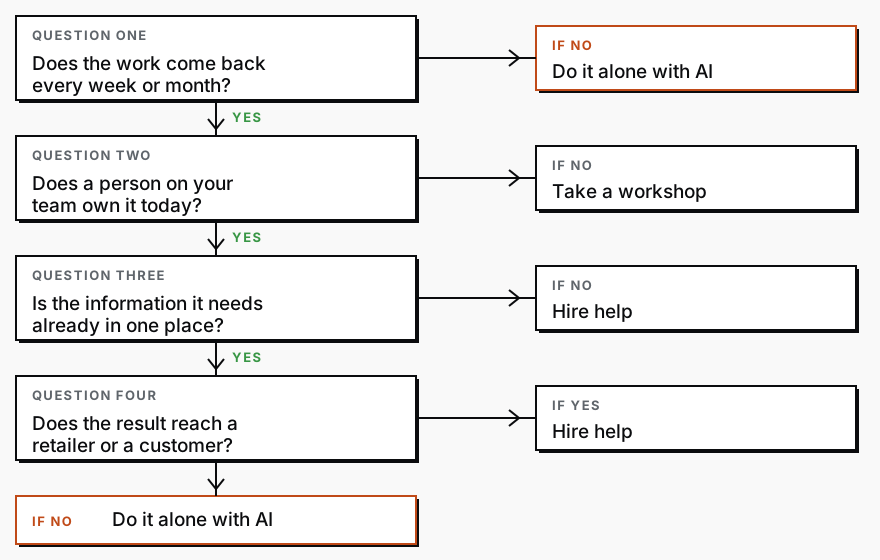
An AI consultant for small business earns the fee on the last two questions. Scattered information means someone has to connect the places it lives, such as the distributor file and your order system. A result that reaches a buyer means someone has to set up a check that stops a wrong answer before it leaves, whether that is a person or a second AI whose only job is to read each result and stop the bad ones. Those two jobs are what you pay for. The first two questions decide whether you need to pay anyone at all.
When is a consultant the wrong answer for a small CPG brand?
Three cases. The work happens once, in which case a monthly fee pays for a job that is over. Or nobody on your team owns it, in which case the consultant delivers a finished thing to nobody, and it is likely to sit unused. A third case hides inside a proposal. Reading, sorting and drafting from files you already own is work AI can do before you pay anyone, and sorting a proposal line by line shows which lines that covers.
Red flag on this path: you did it alone twice and it broke the moment a file changed, or only you can run it.
What does a workshop cover that a consultant does not?
A consultant delivers a finished thing and leaves. A workshop teaches your own people to run, check and extend that kind of thing without calling anyone. That is the right fit when the job is yours to own but you have never started. The AI CPG Workshop teaches an operator to write down what their company sells, charges and may not claim, so AI answers with those facts instead of the category average.
Red flag on this path: you hope the workshop will choose the job for you, or you send someone who will have no time to practice the week after.
What should a founder have ready before the first call?
Four things: the job in one paragraph, the name of the person who owns it, where its information lives, and the one thing it must never do. A firm that needs more than those four to start is billing you for time spent learning your business. You do not need to write that page yourself. The instructions below finish by writing it for you.
When you do hire help, compare firms on what they put in writing. How a CPG founder compares an AI consultant company before hiring covers the four things to ask for.
Red flag on this path: a proposal that cannot say what it connects to, or who answers on the first bad day.
How do you tell the work is ready to hand over?
A new hire could do it from a written description in a week. The same person does it each time. A wrong result is easy to spot when you see one. If the first holds and the others do not, the job is not ready for anyone, and choosing which job to hand over first is the better place to start.
Run your own job through the tree
In the older days you would book calls with two or three firms, read what each proposal left out, and sort it all on a whiteboard with a friend who had bought something similar. A week of calls and a weekend of second guessing, and you would still not be sure.
Today, whoever owns the job pastes the instructions below into Claude, the AI chat assistant from Anthropic, followed by a few sentences describing the job, and the verdict is back in about a minute. If nobody owns it yet, you do it yourself. Your part is reading the answer. (The instructions are what you type in. Paste them as they are.)
Here is what comes back, for an example job: every week the distributor sends a sales file, and the ops lead copies it into a sheet to see which stores are slipping on reorders.
- Recurs: YES. It comes every week.
- Owned by a person: YES. The ops lead.
- Information in one place: YES. The distributor file.
- Reaches a retailer or customer: NO. It stays inside the company.
- Verdict: do it alone with AI. Next step: have the ops lead paste last week's file and ask for the slipping stores. Red flag to watch: the distributor changes the file layout and the list quietly goes wrong.
I run a CPG brand. Below this message I describe one job I am thinking of getting AI help with, in my own words.

Answer the questions below in order, each with YES, NO or CAN'T TELL and one sentence of reasoning taken from my description:
1. Does the work come back every week or every month?
2. Does a named person on my team own it today?
3. Is the information it needs already in one place?
4. Does the result go to a retailer or a customer?

Then choose the path. If 1 is NO, do it alone with AI. If 1 is YES and 2 is NO, take a workshop. If 1, 2 and 3 are YES and 4 is NO, do it alone with AI. If 1 and 2 are YES and 3 is NO, hire help. If 1, 2 and 3 are YES and 4 is YES, hire help.

Name the one next step in a single sentence and the one red flag to watch for on that path. Then write a one-paragraph brief I could hand to a consultant, a workshop host or my own team: the job, who owns it, where the information lives, and what it must never do. If any answer is CAN'T TELL, ask me one question about it before you choose.
If the verdict is hire help and you want an outside view on one job before paying for a build, the CPG AI Assessment is an hour on that one job, then a written scope and a price.
CPG AI Assessment
Fix the CPG workflow that keeps landing back on your desk.
I map the recurring reporting or operating workflow first, then build only when the first useful fix is clear.