By Smári Ásmundsson · · 8 min read
CPG AI: the five jobs AI does in a CPG brand, and where to start
What does AI for CPG brands actually do, and where should a founder start?
AI for CPG brands takes over work that repeats every week. It does that in five places: the weekly numbers, stock, customer support, product pages, and the written rules your team's AI follows. Start with the job that takes the most hours and already has its facts in a file. For many founder-led brands, that is the weekly numbers.
Under each job below you get what AI does there, what to hand it first, and the post with the full method. By AI I mean an assistant you type to in a chat window, such as Claude or ChatGPT. The examples use Claude.
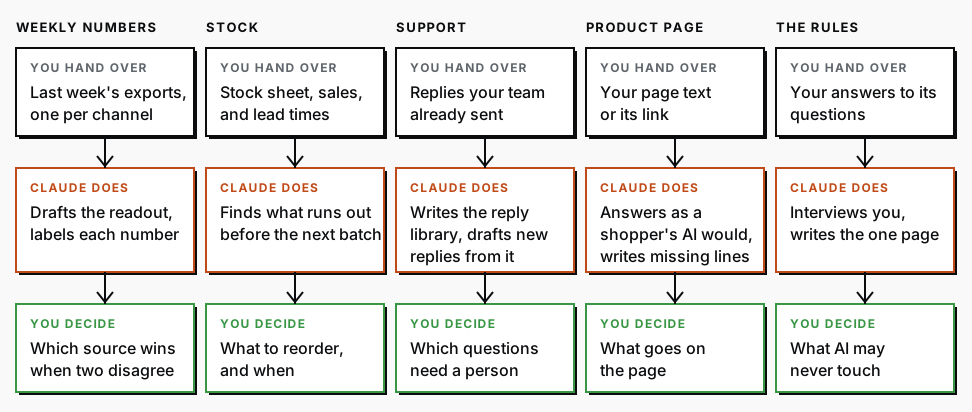
Read the figure top to bottom and your hands are only on the last box. That is the test for any AI advice, including this page. If the first step is for you to audit, list or tally something, the advice is selling you an afternoon.
Where does AI pay off first in a CPG brand?
It pays off where the work repeats every week, pulls facts from more than one place, and gives you something useful even when the first version is imperfect. A weekly readout fits. So does a customer reply and a retailer follow-up. A brand refresh does not, because it happens once.
Each part of your brand also sits at its own level. Your support replies can be well ahead of your reporting. The seven levels of AI for CPG runs from asking a question in a chat window to a system that applies your standards to daily decisions, so you can see where each of the five jobs below sits and what moving it up one looks like.
How do you use AI for CPG reporting and the weekly numbers?
The weekly numbers live in a different place for every channel: Shopify, Amazon, the distributor and broker reports, the stock report, the ad accounts. Someone has to pull them together, decide which figures to believe and explain the week to the team.
AI does that assembly. It pulls the numbers into one view, compares the week to the one before, says what changed, flags what looks off and drafts a plain-English readout, a one-page summary of the week. It also labels every number as current, stale, estimated, missing or conflicting, which matters because AI cannot fix a company that does not know which source to trust. It summarizes the wrong number with more confidence.
So the first step is to hand Claude last week's report from each channel, the spreadsheet or file each one lets you download, and ask for the readout with every number labelled that way. Each conflict it flags is yours to settle once. That is the only decision in the job. If most of your sales go through distributors and brokers, the same job lines their reports up against your own orders and flags where they disagree. Give the job one owner by name, usually whoever runs operations. Each week that person hands Claude the same files, and what breaks first is a source that went stale or changed shape, which is what the labels are there to catch. The method is in AI for CPG brands starts with the reporting bottleneck, and what belongs on the page itself is in the founder's CPG dashboard.
How do you use AI for CPG operations and inventory?
Stock trouble rarely comes from nowhere. Revenue, stock, ad spend and wholesale reorders each sit in a different place, so they are seldom read together until a shortage has a cost.
AI reads those signals together. Take a week where revenue is up and most of the growth is one product with four weeks of stock and an eight-week lead time (an example, not a real brand). A good week and a problem forming are the same week. AI also catches the case where paid ads are pushing a product that is about to run out, so you are paying to create demand you cannot fill.
The first step is to hand Claude your stock sheet, the last four weeks of sales by product and each product's lead time. Ask which products run out before the next shipment lands, what is driving each one, and whether ads or a wholesale reorder is behind it. You decide what to reorder. The method is in inventory risk should show up before it gets expensive.
How do you use AI for customer support in a CPG brand?
The same questions arrive every week. Is it gluten free, where is my order, the seal arrived broken. From retail buyers and distributors it is the spec sheet, the case pack, the lead time and the minimums. Whoever is on shift answers from memory, a little differently each time, and a customer who gets two different shipping times in a month learns that your policy depends on who reads the email.
AI writes a library of standard replies from the replies you have already sent. It drafts each new reply from that library and leaves the draft for you to send. Once a week it reads what your team actually sent and updates the library, so a correction someone made before sending becomes the way the next draft starts. Questions about health, pregnancy, allergic reactions, injury or legal threats go into a group that always goes to a person, with no standard reply.
The first step is the first set of instructions in support replies that learn from what your team sends. It has Claude search 60 days of your support email, group the questions, and write the library. Where two of your past replies disagree, it lists the disagreement instead of choosing. That list is the decision that stays with you.
How do AI shopping helpers and AI search read a CPG brand's product pages?
A shopper can type into ChatGPT or another AI assistant and ask whether your product contains the one thing they will not buy. That is AI search, and the assistant doing the answering is a shopping helper. The shopper never opens your site. They read the answer they get and either add to cart or move on.
The assistant reads the words on your page. The ingredient panel or nutrition table, if it is a photograph, often arrives as little more than a file name, so the numbers inside it may not be there to read. The fix is plain sentences next to the image. If most of your sales go through distributors and retailers, the same applies to the retailer's listing for your product, which the assistant sometimes reads instead of your own page.
The first step is to give Claude your product page and have it answer the way a shopper's AI assistant would: what is this, what is in it, what does it cost, who is it for. It then tells you which answers it got wrong or could not find, and writes the exact sentence to paste beside each image. What goes on the page is your call. The full method, including a second check on which other pages the assistant quotes instead of yours, is in your product page has two readers.
How does a CPG team keep AI from making things up?
Give it your facts and your limits on one page. AI invents a retailer policy or a price when it has no file to read and no rule to follow, and a longer lecture on responsible use does not change that.
An AI playbook has four parts: the tasks AI does, the files it reads, what needs a person's approval before it goes anywhere, and what it never touches. The AI reads the page before it starts any task. You do not write it. Claude interviews you one question at a time and writes the page, and one named person owns keeping it current. The method, with a finished example for a made-up brand, is in how to write an AI playbook for your CPG team.
The same idea shows up inside the other four jobs. The labels on each number in your reporting and the group of questions that always go to a person in support are both limits written down where the AI reads them.
What should a CPG founder automate first?
Pick the job that costs the most hours a week and has a file the AI can read. If two jobs tie, pick the one where a wrong answer is cheapest to catch. What should a CPG founder automate first? gives five questions for scoring a candidate: does it happen every week, does it cost founder time, does it need information from more than one place, does it support a real decision, and would a first version be useful even if it is not perfect. The CPG AI Assessment takes one of the five apart with you in an hour.
In the older days you would book a day with your operations lead, list every recurring task on a whiteboard, estimate the hours each one costs, mark which ones have a file behind them, and argue over the ranking. That is about a day of two people's time (illustrative, yours will differ), and the ranking is out of date by next quarter.
Today you let Claude do the interviewing and the ranking. Paste the text below into Claude or ChatGPT. (This kind of text is called a prompt: just the instructions you type in. Paste this one as it is.) It asks you questions one at a time and ranks the five jobs at the end.
Interview me to decide which job in my consumer packaged goods company to hand to AI first.
Ask one question at a time and wait for my answer.
Cover these jobs, one at a time: the weekly numbers, stock and operations, customer support, product pages, and the written rules my team's AI follows.
For each job ask: how many hours a week it takes and who does it; where the facts it needs live today; how often a mistake in it reaches a customer or a buyer; and whether a draft would still be useful if it were imperfect.
Ask a follow-up whenever an answer is vague.
When you have enough, rank those jobs. For the top one, say in plain words what I should hand you first, which files I should give you, and the one decision that stays mine.
Then ask me what you got wrong and fix it.
You answer the questions and Claude does the weighing. What you get back is one job, the files to give it, and the decision you keep.
Sources
No outside facts are stated on this page. The description of each method comes from the linked posts.
CPG AI Assessment
Fix the CPG workflow that keeps landing back on your desk.
I map the recurring reporting or operating workflow first, then build only when the first useful fix is clear.