By Smári Ásmundsson · · 6 min read
What an AI implementation consultant does for a CPG brand in the first month
What does an ai implementation consultant do for a CPG brand in the first month, and what should the founder hand over?
It is day three, and the consultant has emailed asking for the logins to your Shopify store, your distributor portal, your Amazon account and your bank feed, all in one message. You do not know which of those they need, or what happens to your business once you send them.
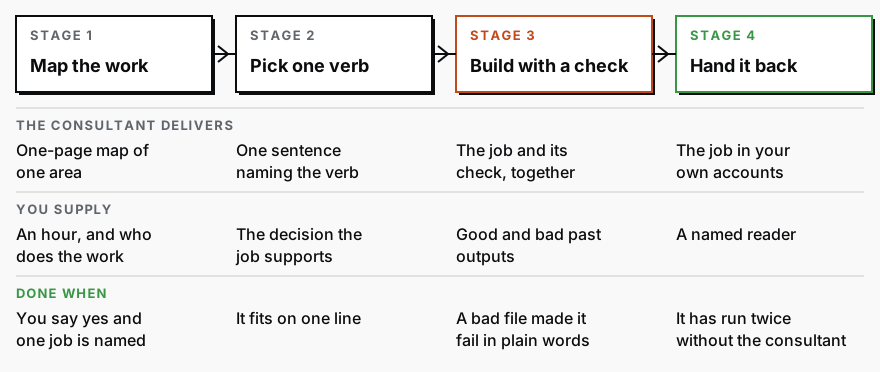
An AI implementation consultant should spend your first month on four stages: map the work, pick one verb, build with a check, and hand the running job back. At each stage they give you something you can read, you give them a short list, and there is a sign the stage is finished. You hand over the access for one job, and nothing else.
What does the first week of an AI implementation look like?
A job here is one chore the AI does on a schedule, such as sending a weekly reorder reminder to wholesale accounts. Stage one is mapping the work around one such job, in one area such as reporting or wholesale. Each part of a CPG business sits at its own level of AI use and moves up one at a time, which is why the first month stays inside one area (The seven levels of AI for CPG shows how they differ).
The consultant delivers a one-page map of one area: who does the work today, which files it touches, and where you are the bottleneck. You supply an hour of description and the names of the people who do the work. It is done when you read the page and say "yes, that is how it works", and the page names the one job to build first.
To choose that job, I use five questions from What should a CPG founder automate first?: does it happen every week, does it cost founder time, does it need information from more than one place, does it support a real decision, and would a first version be useful even if it is not perfect.
Stage two: what is the verb?
The verb is the one thing a person does with the job's output, such as approve, send, resolve or kill. The consultant delivers one sentence: this job will do one thing so that you can decide one thing. I built an internal dashboard once with a page for every table and no verb on any of them, and it was useless the first time I tried to act on it. I wrote that up in Build around the verb, not the data.
You supply the decision. It is done when the sentence fits on one line and you can picture the one page the output arrives on.
Stage three: what does build with a check mean?
The consultant delivers the running job and its check together: the dated output that proves it ran, and the message you get when it fails. You supply three or four past outputs you consider good and one you consider bad, so the job has something to match. It is done when the consultant has fed the job a bad file on purpose and shown you the failure message.
The check is not optional. A system I built passed 121 automated tests and still produced junk, because every test asked whether the machinery ran and none asked whether the output was good. That is in Green tests measure the wrong thing.
Stage four: how does the job come back to you?
The consultant delivers the job running in your own accounts, a one-page note on what it does and who reads its output, and a way to switch it off. You supply a named reader. It is done when the job has run on its own schedule at least twice without the consultant touching it, and the note says who fixes it when it breaks.
What access and files does a founder need to hand over?
One job's worth, and no more. For a weekly reorder reminder to wholesale accounts, that is read-only access to the sales export, a list of accounts with their last order dates, three past reminders you liked, and the rules you never break, such as never offering a discount. It is not your bank login, an admin account on every system, or files from areas the job does not touch.
In the older days you would trade emails with the consultant for a week, each round asking "do you also need this?", and you would assemble the list from memory. Say two hours of your time and three rounds of messages, with something missing at the end anyway.
Today it takes a few minutes, most of them spent typing two sentences about the job. Whoever looks after your systems, not you, opens Claude, the AI chat tool, and pastes the instructions below with those sentences under them. Claude sends back a handover list like this one:
| Item | Where it lives | Who owns it | Access to give |
|---|---|---|---|
| Sales export, last eight weeks | Distributor portal | Ops lead | A downloaded file, no login shared |
| Account list with last order dates | Order system | Ops lead | Read-only view |
| Three past reminders you liked | Sent folder | You | Copies of the emails |
| Rules you never break | In your head | You | A short written list, from you |
| Who approves anything that goes out | Not written down yet | You | One name |
Here are the instructions to paste:
I am going to describe one recurring job in my company that I want an AI to run. List everything a consultant needs from me to build it and nothing more, as a table with four columns: the item, where it lives, who owns it, and the least access needed to share it, such as a downloaded file or a read-only view. Add a row for anything that is in someone's head rather than written down. Do not ask for logins to systems the job does not touch. My job is described below.Claude can miss an item, so treat the table as a draft. Your part is reading it and crossing out anything you do not want to share. The ops lead or bookkeeper runs the instructions and collects the files.
How does a founder tell real running work from a demo?
A demo runs once, on a file the consultant chose, while they watch. Running work has three signs. It ran on its schedule without anyone starting it. It left a dated output you can open yourself. And when it was fed a bad file, it said so in plain words. Ask to see it on a day the consultant did not touch it.
What should be left behind when the consultant finishes?
Six things: the job in your own accounts, the one-page note on what it does, the name of the person who reads its output, the failure message and who receives it, the way to switch it off, and a list of every access you gave with each one either removed or kept on purpose. If you cannot switch the job off yourself, you do not own it yet.
If you want the first stage done for you, the CPG AI Assessment is an hour on one job, then a written scope and the price to build it.
CPG AI Assessment
Fix the CPG workflow that keeps landing back on your desk.
I map the recurring reporting or operating workflow first, then build only when the first useful fix is clear.