By Smári Ásmundsson · · 6 min read
AI Consultant Services for a CPG Brand: Which to Buy, Do With AI, or Wait On
What do AI consultant services cover for a CPG brand, and which of them can a founder skip?
A proposal arrives from an outside firm: a strategy session, an audit, a build, a training day and a monthly retainer, with one price at the bottom. Sign it as written and you may pay a retainer for work you could have had done this week, or skip the one line your business needed. AI consultant services for a CPG brand come down to those five kinds of work, and each line sorts into one of three answers: buy it, do it with AI, or wait.
What kinds of work do AI consultants sell?
Five. A proposal usually bundles several of them under one number.
Strategy is a plan: where AI could help in your business and in what order. An audit is a look at what is true today, such as which weekly reports take your team longest and where two numbers disagree. A build is a working thing, such as a report that assembles itself from your order system and your distributor files. Training teaches your team to use what exists. An ongoing run is the firm keeping it all working month after month.
These are different sizes of job with different risks, and they should not be priced as a single block. The first thing a good proposal does is show the five apart.
Which of those can a founder do with AI already?
Two questions sort any line. The figure shows the order to ask them in.
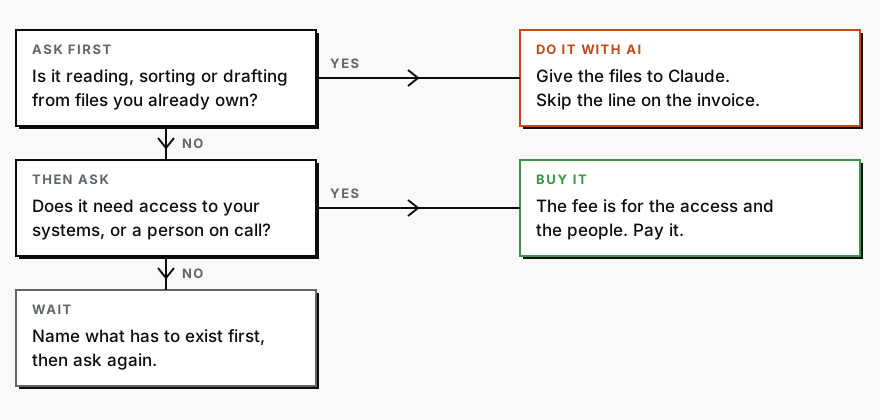
Ask first: is the work reading, sorting or drafting from files you already own? A first strategy pass often is. Your sales files, your product pages and last quarter's reports hold most of what a first plan needs, and Claude, the AI chat assistant from Anthropic, can read them and propose an order. The first pass of an audit is often the same job: which reports take longest, where two numbers disagree. Treat that pass as a draft you check before acting on it. Those lines you can do with AI before you pay anyone for them. If you want help choosing which job to start with, what to automate first walks through it, and why reporting is usually the first bottleneck explains why so many brands land on the same one.
Then ask: does the work need access to your systems, or a person on call? A build that connects to your order system, your accounting or a retailer portal needs someone to set up and secure that access, and someone to answer when it stops. An ongoing run is a person on call by definition. This is what the fee covers.
If neither question gets a yes, the line is waiting on something. Training before anything exists to train people on is the usual case. Name the thing that has to exist first, then ask again.
One case where the first question misleads you: a line that looks like reading and sorting but touches customer records, payment details or live orders. Keep that out of a chat window until someone who knows your data obligations says it may go in. Buy that one, or have it done by someone who already holds that data.
How many lines you can take on yourself depends on where each part of your business stands today. The seven levels of AI for a CPG company shows how to place each part, because a brand can be well along in reporting and barely started in customer service.
What does an audit hand back that a build does not?
An audit hands back a finding in writing: what is true today, ranked by what it costs you. A build hands back a thing that runs. They protect you from different mistakes. A build bought without an audit is built on a guess about what hurts most. An audit bought without a build is a document you carry around.
When a firm sells both, ask whether the audit's last page names the build, with what it connects to and what stays with a person. A good audit should still be useful if you hand it to a different firm.
What should the first engagement produce?
One working thing, and the written reason it came first. A reporting task that now assembles itself, a set of customer replies your team edits and sends, a sorted list of reorders. It should be something your own people can open the day after delivery and say whether it is right.
If the first engagement ends in slides, you have paid for the plan you could have had from the first question above.
Sort the proposal in front of you
In the older days you would take the proposal, read each line twice, call a founder who had bought something similar, and build a spreadsheet of what each line meant and what it would cost you to say no. Call it three hours, and you would still be unsure about the retainer.
Today, you or whoever pulls your sales files pastes the proposal into Claude, and a first sort is back in about a minute. Both times are rough. The sort is a first pass and it gets things wrong. It misses most on vague lines, which is why the instructions below make it mark those WAIT, and on anything that touches your data, which a person has to read. Check the one line you are about to pay for. Here is what comes back, using a made-up proposal:
| Line on the proposal | Kind | Verdict | Reason |
|---|---|---|---|
| Two-day strategy workshop | Strategy | Do it with AI | Built from your own exports and pages. Ask Claude for the plan first. |
| Reporting audit | Audit | Do it with AI | A first read of your own reports for gaps and mismatches. |
| Weekly sales report, pulled from your distributor and order files | Build | Buy it | Needs access to those systems set up and secured by someone. |
| Team training day | Training | Wait | Nothing built yet to train on. |
| Monthly retainer | Ongoing run | Wait | Nothing to run until the build exists. |
Under the table it adds what the first engagement should produce (the weekly report, running on your own files) and one question to ask before signing: who owns the connections to my systems if we stop?
You paste this, along with the proposal or the services page from the firm's website, underneath it:
Below is a proposal from an outside firm that sells AI help to food and drink brands. Split it into its separate lines of work and sort each line into one kind: strategy, audit, build, training, or ongoing run.

For each line, give me one verdict:
BUY IT if it needs access to my systems, a person on call, or skills my team does not have.
DO IT WITH AI if it is reading, sorting, comparing or drafting from files I already own. Add one sentence on how I would ask an AI chat assistant to do it.
WAIT if it depends on something that has to exist first. Name that thing.

Show a table with four columns: line, kind, verdict, reason in plain words. If a line is too vague to sort, say so and mark it WAIT.

Then tell me in two sentences what the first piece of work should produce, and give me one question to ask the firm before I sign. Do not rank or recommend the firm.

[paste the proposal underneath this line]
Your part is reading the table. The pasting is two minutes for you or whoever pulls your sales files, and the question at the bottom is the only thing left that needs you on a call.
If you would rather run the sorting against one of your own projects than a stranger's proposal, the CPG AI Assessment takes one job of yours apart and returns a written scope, a price to build it and the hours it gives back.
CPG AI Assessment
Fix the CPG workflow that keeps landing back on your desk.
I map the recurring reporting or operating workflow first, then build only when the first useful fix is clear.