By Smári Ásmundsson · · 6 min read
AI consultant company: how a CPG founder compares one before hiring
How does a CPG founder compare an ai consultant company before hiring one?
Three proposals are in your inbox from firms that all say they do AI for brands like yours. The deliverables are worded differently, the prices cannot be compared, and you cannot tell what you would own in six months. Compare an AI consultant company on four things it will put in writing before you sign: what you get, who does the work, what it does with your files, and what happens on the first bad day. First decide whether you need a company at all, because some of this work goes to one freelancer and some you can do yourself.
How do you decide between doing it yourself, a freelancer and an AI consultant company?
Ask three questions in order. The figure shows where each answer lands and what should end the conversation at each stop.
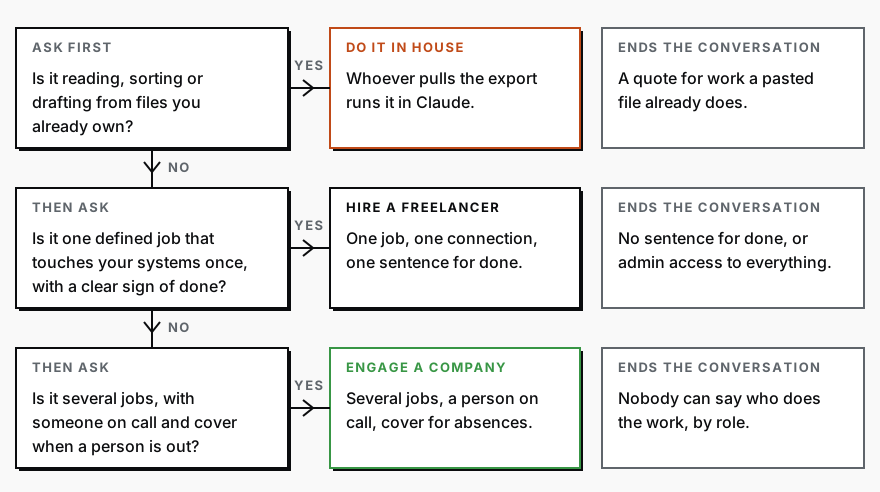
Is the work reading, sorting or drafting from files you already own? Then do it in house. Claude, the AI chat assistant from Anthropic, can turn a distributor export into a weekly summary, and whoever pulls that export can run it. If a firm quotes you a build for that, ask what it does that a chat window does not. The red flag is a proposal with no answer.
Is it one defined job that touches your systems once, such as a report that assembles itself from your order system? Then a freelancer is usually enough. The red flag is a freelancer who cannot say in one sentence what "done" looks like, or who asks for the keys to every system when the job touches one.
Does it need several jobs, someone on call, and cover when a person is out, month after month? That is what a company is for. The red flag is a sales call where nobody can say who would do the work, by role, and who covers when they are away.
What should an AI consultant company show before you sign?
Four things, in writing, before any money moves.
The scope. One deliverable per line, each with a sign that it is finished, worded so you could check it yourself. "Report built" is not a sign. "The report reached your inbox twice without anyone touching it" is. What an AI implementation consultant does for a CPG brand in the first month lays out what each stage should hand you.
Who does the work, by role. A person who builds, a person who checks, a person who answers when it stops. Names are nice. Roles are what you can hold them to.
What happens to your files. Where they are kept, who can see them, what happens to them when you leave, and that nothing from your business is shown to another client. A company that offers to show you another client's finished work has told you what it will do with yours.
What happens on the first bad day. An export changes a column name, a login expires. The company should say in advance what message you will get and who reads it. What an AI automation consultant should prove before the job runs for real covers the four proofs.
Which red flags end the conversation early?
Five of them, and any one is enough.
- The company offers to show you another client's work, prices or results as proof.
- A proposal asks for logins to everything before it names the one job.
- A price arrives with no scope under it, or a scope with no end date.
- Nobody can say who reads the results every day once the job is running.
- The promise is an outcome ("transform your operations") with no description of the check that would show whether it happened.
Each of these is visible before you pay.
When is a freelancer enough?
When the work is one job, you can write what done means in a sentence, someone on your team will read its results every day, and a few days' delay when it breaks costs you an annoyance and not an order.
A freelancer is one person, so the question is cover: who looks after the job during their holiday? If the answer is nobody, the job should be small enough that nobody is fine. If it is not small enough, you have just described a job for a company. For help sorting which lines of a proposal you can do yourself, AI consultant services for a CPG brand: which to buy, do with AI or wait on walks through the order to ask in.
What should you own when the contract ends?
The job running in your own accounts, not theirs. A one-page note saying what it does and who reads its results. The instructions and files it uses. A way to switch it off that does not need their help. And a written statement that your files are deleted from their side.
If any of it sits in their accounts, you are renting. You will find out on the renewal date.
How do you score a company from its public pages?
In the older days you would open each company's site, read every page, hunt for the terms and privacy pages, and fill in a grid by hand for each firm. Say three hours a company, so most of a day for three, and at the end the grids do not line up.
Today you, or whoever handles your vendor emails, opens Claude, pastes the instructions below with the text of one company's pages underneath, and has a scorecard back in under a minute. Your part is reading it. Here is one, for an invented Company A:
| Question | What the pages say | Result |
|---|---|---|
| What do you get, in writing? | "Services: strategy, build, training." No deliverables or finish signs | Ask before signing |
| Who does the work? | Names the two people who run each project and what each does | Clear |
| What happens to your files? | The privacy page covers the website only. Nothing on client files | Ask before signing |
| Do they show other clients' work? | "See our case studies", with named brands | Red flag |
| What do you own at the end? | Not stated | Ask before signing |
| How is it priced? | Monthly retainer, no scope listed | Ask before signing |
"Not stated" does not mean bad. It means one more question, and the answer goes into the proposal in writing. The scorecard writes those questions for you. Paste the home page, the services page, and the terms and privacy pages under the instructions:
Below is the text from the website of an AI consulting company that a food and drink brand is thinking of hiring. Score it against six questions: what the company says you get, in writing; who does the work, by role; what happens to a client's files; whether it shows other clients' work or results; what the client owns when the contract ends; and how it is priced. For each question, quote the exact words from the text that answer it. If the text does not answer it, write "not stated". Then mark each question Clear, Ask before signing, or Red flag. Treat an offer to show other clients' work as a Red flag. Do not rank the company or say whether to hire it. Finish with the questions I should send the company, one for each "not stated".Run it once per company and lay the scorecards side by side. If you want a second set of eyes before you choose, the CPG AI Assessment is an hour on one job, then a written scope and the price to build it.
CPG AI Assessment
Fix the CPG workflow that keeps landing back on your desk.
I map the recurring reporting or operating workflow first, then build only when the first useful fix is clear.