By Smári Ásmundsson · · 5 min read
Autonomous AI agents: which CPG jobs should run without a person watching
What do autonomous ai agents do without a person watching, and which CPG jobs should run that way?
A supplier email gets answered, a listing gets changed and a report goes out under your name, and you were asleep for all of it. Autonomous AI agents do the job themselves, with nobody typing each step, and how much you let them do alone comes in four steps rather than one switch: AI suggests, AI drafts, AI acts and a person checks after, AI acts alone. Few CPG jobs belong on the fourth. A job climbs one step only after it passes a test, and each step needs its own check.
What do autonomous AI agents do when nobody is watching?
They read the input, decide the steps and take the action, then move to the next item. That separates them from an automation. An automation follows the steps you wrote, so the same input gives the same output every time, and it stops dead when something unexpected arrives. Tell an automation to copy the distributor file into one folder and it does that, every time. Tell an agent to keep the shared folder tidy and it decides which files go where, so it can handle the unexpected, and it can also do something you did not expect. One AI helper or a chain of them covers the difference in more detail. That is why each step needs its own check.
What are the four steps of the ladder, and what check does each need?
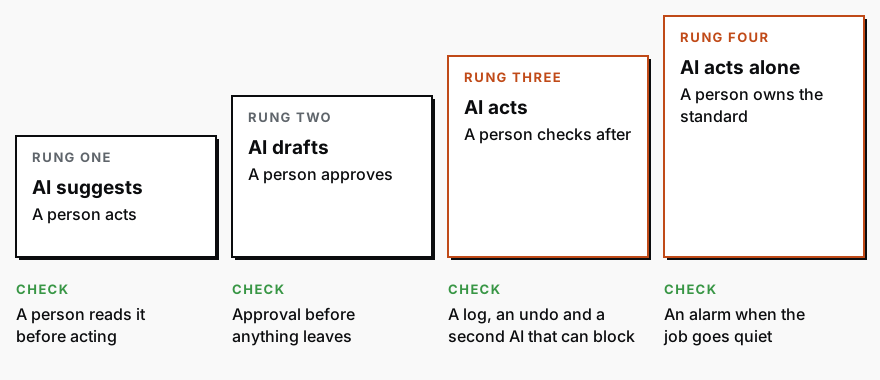
On the first rung AI reads your inputs and proposes what to do, and a person does it. On the second it produces the finished thing, such as a reply to a wholesale buyer, and a person approves it before it goes anywhere. On the third it takes the action and a person looks afterward, which only works if there is a log, a plain list of what it did and when, and a way to undo each action. Whoever owns the job reads that list over coffee and undoes anything wrong. On the fourth it acts alone, and a person owns the standard and reads a summary. The check at that rung is an alarm that fires when the job goes quiet, because a job that silently stops looks identical to a job that works.
The third rung is where a second AI earns its place, one whose only job is to read each result and stop the bad ones. The AI that audits the AI shows what it looks like when a checker is allowed to block the first one's output. The check has to test the result, not the machinery: how a job can pass every check and still be wrong shows why.
How does a job move up a rung?
It passes a test, and the test is the same shape each time. The job has run on its current rung long enough that you stopped changing its output. A wrong result at the next rung can be undone. And a deliberately wrong input, slipped in on purpose, was caught by the check. A rule of thumb for the first part is ten results in a row accepted without an edit. Treat the number as a starting point, not a law. Treat AI like a hire makes the same case: a probation period before anything touches what matters.
Which CPG jobs should never run without a person?
Anything that cannot be undone, and anything that speaks for you to a buyer or moves money. Sending prices to a retailer, disputing a deduction with a distributor, changing a claim on a label or a listing, paying an invoice, deleting records. These stay at the second rung at most, and some stay off the ladder entirely. The jobs that climb furthest are internal and reversible: filing last week's distributor export under the right name, sorting support emails into piles, drafting the weekly summary. An example of where jobs land:
| Job | Starts on | Check it needs |
|---|---|---|
| Sort incoming support emails into piles | Rung 3 | A daily list of what it sorted, one-click undo |
| Draft replies to wholesale buyers | Rung 2 | Approval before anything is sent |
| Choose which stores get sample cases | Rung 1 | A person reads the proposal and sends the cases |
| Send a new price sheet to a retailer | Off the ladder | A person writes and sends it |
Place your own jobs on the ladder
In the older days you would put every recurring job on a whiteboard with your ops lead and argue each one: what happens if it goes wrong, who would notice, can it be undone. An afternoon, and the argument comes back whenever a new tool appears.
Today, whoever runs operations pastes the instructions below into Claude, the AI chat assistant from Anthropic, along with a rough list of the recurring jobs, and the table comes back in about a minute. Your part is reading it and deciding which rows you accept. (The instructions are what you type in. Paste them as they are, then list your jobs underneath.) The answer looks like the table above, one row per job.
Below I list the recurring jobs in my CPG brand that I am thinking of handing to AI.

Place each job on this ladder: 1 AI suggests and a person acts. 2 AI drafts and a person approves. 3 AI acts and a person checks afterward. 4 AI acts alone.

Decide the rung by asking four things. Can a wrong result be undone within a day? Does it reach a retailer, a customer or a payment? Would anyone notice within a week if it went wrong? Has a person already done it the same way many times? Anything that cannot be undone, or that reaches a retailer, a customer or a payment, stays at rung 2 at most.

Answer in a table with one row per job: the rung it can start on, the check it needs at that rung, and the one test it must pass to climb to the next rung. Then list any job that should not be handed to AI at all and say why. If a job is described too thinly to place, say what is missing instead of guessing.

My jobs:
If a job lands on the third rung and you want it built with its log, undo and checker already around it, Workflow Build is where Nordic Navigators builds one recurring job to run on its own with the checks in place.
Services
Workflow BuildYou stop doing the job that keeps coming back, and it stops being the thing that slips when the week gets busy. Those hours go back into the work that actually grows the brand.
CPG AI Assessment
Fix the CPG workflow that keeps landing back on your desk.
I map the recurring reporting or operating workflow first, then build only when the first useful fix is clear.