By Smári Ásmundsson · · 5 min read
Claude Pro vs ChatGPT Plus: Which One a CPG Founder Pays For
Claude Pro vs ChatGPT Plus: which one should a CPG founder pay for?
Somebody on your team wants a paid AI assistant, and the two names you keep hearing are Claude Pro and ChatGPT Plus. Every comparison you find is a table of features you will never touch. Pay for whichever one does your own five jobs better. You find out by running those jobs in both and scoring the answers side by side. Whoever keeps your files pulls the five items, and after that it takes about twenty minutes. Whoever pulls your distributor export does the pasting. You read the scorecard.
The old way to choose
In the older days you would pay for both for a month, use one for a week, switch, and keep notes in a doc. Four weeks later you had a feeling. The feeling was built on whichever answer you saw last, because the two weeks never contained the same work.
Today you run the same five jobs in both on the same afternoon and have a scorecard in twenty minutes, most of it spent waiting for answers.
What comes back
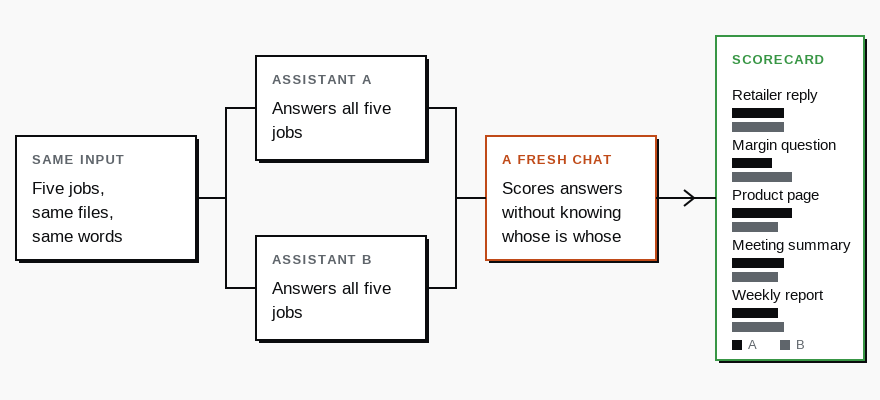
This is the scorecard you are asking for. Each row is one job, scored out of 10 on one question: could I send this as it is?
| Job | A | B | Winner | What cost the loser |
|---|---|---|---|---|
| Reply to a retailer | 8 | 8 | tie | nothing |
| Margin question on a pasted export | 6 | 9 | B | A used the wrong column for cost |
| Rewrite a product page | 9 | 7 | A | B added a claim the page never made |
| Summarize a meeting | 8 | 7 | A | B dropped the owner on two actions |
| Write the weekly report | 7 | 8 | B | A buried the one number that moved |
You decide from the last column. A three-point gap on the margin question matters more to a seven-figure brand than a tie on the retailer reply. A table of features cannot tell you that.
The test to run
Open a new chat in each assistant. A chat is the window where you type to it. Whoever runs this pastes the same instructions into both. The material for each job goes underneath: the retailer's email, the export, the product page, the meeting notes, last week's numbers. A prompt is just the instructions you type in, and this one runs as printed:
Do these jobs in order, using the material I paste under each one. 1. Reply to this retailer email. 2. Answer my margin question from this export. 3. Rewrite this product page. 4. Summarize this meeting. 5. Write this week's report.When both are done, open a third chat and paste both sets of answers, labeled A and B without saying which assistant wrote which. Ask it to score each answer 1 to 10 on whether you could send it as it is. Ask for a table of scores, the winner of each job, and the one fault that cost the loser points. Open that third chat in either assistant. With the labels hidden it cannot easily tell which answers are its own, which matters because a scorer that knows may lean toward itself. If the scores look lopsided, run the scoring again in the other assistant and see whether the winners hold.
What can each entry plan do that the other cannot?
Less than the marketing suggests. On their pricing pages, Claude and ChatGPT both list the same everyday things. They are shared folders for a project, memory of what you told it, longer web research, tasks on a schedule and work with your files. Claude lists Pro at $20 a month billed monthly. The edges differ. Claude Pro lists a link to Microsoft 365, and ChatGPT Plus lists custom GPTs, which are saved setups for a job you repeat. Those lists change often, which is the reason to trust your scorecard over any list, this one included.
Which jobs does the choice actually change?
Usually fewer than you expect. A retailer reply and a weekly report tend to score close, as the tie in the example shows. The choice shows up where a job touches something specific: a spreadsheet you paste in, a tool you already live in, a task you repeat every week. If your five jobs are all writing jobs, the two plans may be a coin flip, and then the cheaper month wins. If one of them is a margin question on a messy export, run that row twice with two different exports. It is the row most likely to separate them.
Once you have chosen, the five instructions a CPG founder should save are the first things to put in it. Seven levels of AI for CPG shows where this sits.
What breaks when you outgrow the entry plan?
You hit a limit in the middle of a job. Neither page gives a number. Claude's page shows Pro as a base amount of use every five hours and every week. It says how fast you reach a limit depends on the chat length and the size of the files. ChatGPT's page says Plus has expanded messages and uploads, with limits that apply. Both have a plan above, Claude Max at five times Pro's usage and a ChatGPT Pro tier. What you buy there is mostly more room before the limit.
So add one row to your scorecard: your biggest real file, pasted into a long chat. The day a reply tells you that you have reached the limit is the day to look at the next plan. It is not the day to switch assistants.
The other thing that breaks is the person. A subscription gives your team a place to type. It does not give them the five jobs, written down in an AI playbook. Someone still has to own those jobs and check the output when a new version changes how the assistant answers. Both plans leave that gap open. If you want it closed, our CPG AI Assessment is where we start.
CPG AI Assessment
Fix the CPG workflow that keeps landing back on your desk.
I map the recurring reporting or operating workflow first, then build only when the first useful fix is clear.