By Smári Ásmundsson · · 6 min read
No code AI agents builder: how a CPG founder judges one
How should a CPG founder judge a no-code AI agent builder?
Picture the morning an AI helper sent a retailer last month's promotion price, and you cannot find out what it did or why. Four questions keep that morning from happening when you pick a no-code AI agent builder. (An agent is an AI helper that does a job on its own, step by step. No-code means you set it up by typing and clicking, not by programming.)
Can you see every run, meaning each time the helper did its job? Can it stop and ask you before a step you cannot undo? Does a named person hear about a failure the same day? Does the vendor warn you before it changes the model, the AI engine underneath? Each answer sends the job to one of three places: build it in the tool, buy a finished product or use a plain script (a small program that runs at a set time and does the same steps every time), or leave the job manual.
The decision tree is below. After it comes a way to have AI test any builder for you before you pay.
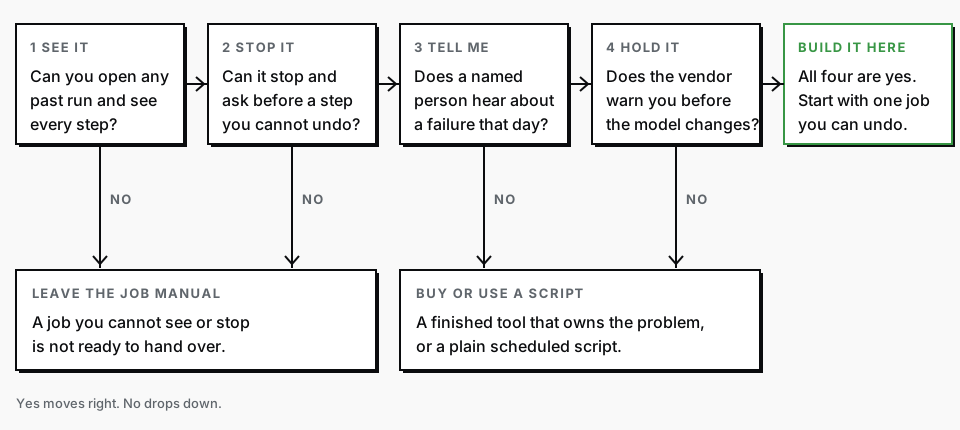
The first two questions are about trust, and a no on either one ends the search. A tool that hides what it did, or cannot pause before it acts, is a bad place to hand over any job, however good the demo looks. The last two are about upkeep, and a no there does not kill the idea. It means someone else has to own the problem, either a vendor whose whole product is that one job or a small script you control. If you would rather not own the script, Workflow Build / AI Concierge puts one job to work in your own accounts and monitors it after it goes live.
What must a builder show you after each run?
Four things, for every run, without you asking support. What started it. Each step it took, with what went in and what came out. Which model ran. And whether it finished, failed or stopped partway.
A list of green ticks that says "success" does not count. A tick tells you the tool did not crash. It does not tell you the tool did the right thing, and the wrong-but-confident run is the expensive one. If you cannot open last week's run and read what it did to a single row of data, you cannot tell a good week from a bad one.
Which steps should never run without a human gate?
A human gate is a point where the agent stops and waits for a person to say yes. Put one in front of anything you cannot take back, or that someone outside your company will see. Sending an email to a retailer or a broker. Changing a price or a promotion in a retailer portal. Paying a bill. Deleting records. Messaging customers.
Reading, summarizing, drafting and filling in your own spreadsheet can run alone. The rule that works is simple: the agent drafts on its own and a person sends.
A gate has one more cost that people forget. A gate nobody answers is a stalled job. Name who answers, and decide what happens if they do not answer by a set hour. The safe default is that nothing goes out.
What breaks when the underlying model changes?
Vendors update and retire the models behind their tools. The same instructions can then produce a different result: a table in a new layout, a number rounded another way, an answer that is more cautious than it used to be. If the builder picks the model for you and does not say so, your job changes and nobody tells you.
Two things protect you. The builder should show which model ran in each run, let you stay on the one you tested, and tell you before it moves you. And you should keep five sample inputs with answers you have already checked, so that after any change you can see whether the job still gets them right. Claude (an AI assistant you type to, like a text conversation) can build that set from your last five real examples, which is work a founder should not be doing by hand.
When is a plain scheduled script better than an agent builder?
A scheduled script is a small program that runs at a set time and does the same steps every time. If the steps never change, a script beats an agent. Pull last week's export, add two columns, email the sheet to yourself. There is no model to change, nothing to guess, and when it breaks it breaks loudly, with an error rather than a plausible wrong answer.
You need an agent when the job involves judgment on messy input: reading a broker's email and deciding what it is asking for, or deciding which of three similar product names a line on an invoice refers to. If you can write the job as a fixed list of steps, ask for a script. You do not write it. Describe the job to Claude in plain words and ask for a script and the exact steps to schedule it.
How to test a builder before you buy
This part is for whoever in your company sets up software. Hand them this page.
In the older days you would book demos with three vendors, sign up for trials, read each one's documentation, build the same small job in each, and email support four questions. That is about six hours spread over a few evenings, and at the end you are still judging a sales demo.
Today, give this to Claude and you have the scorecard in thirty seconds. Open Claude, or the AI assistant you already use, and paste the text below. (It is just instructions you type in, and you can paste it as it is.) Then paste the builder's website text, its documentation and its pricing page underneath it.
I am a CPG founder deciding whether to buy a no-code AI agent builder. Below this message I will paste the builder's website text, documentation and pricing page. Use only what I paste. Answer each question with Yes, No or Not stated, and quote the sentence that proves it.

1. Can I open any past run and see every step, what went in, what came out, and which AI model ran?
2. Can I make a step stop and wait for my approval before it sends, pays, deletes or changes anything?
3. When a run fails, who is told, how, and how fast?
4. Does the vendor tell customers before it changes the AI model underneath, and can I stay on the one I tested?

Then give one verdict. If the answer to 1 or 2 is No or Not stated, say "Leave the job manual". If the answer to 3 or 4 is No or Not stated, say "Buy a finished tool or use a plain scheduled script". If all four are Yes, say "Build it here". Then name the biggest risk in one sentence. For every Not stated, write the question I should send the vendor in writing. Do not guess.
Anything marked "Not stated" is a question for the vendor, and the answer you want comes in writing. A vendor who will not put the stop-and-ask answer in an email has given you the answer.
The checklist runs on the vendor's own words, so it tells you what the vendor claims, not what the tool does. The trial is where you confirm the claims. Run one low-stakes job through it, give the trial to the person who will own the job, and have them open the run afterward.
Where this fits
Deciding which agent to start with is a separate question, and Which AI agents should a small CPG brand use, and how should it choose covers it. The idea that the checker should be a different thing from the doer is in The AI that audits the AI, and what to hand over and what should check the work is in AI agents for ecommerce.
Services
Workflow BuildYou stop doing the job that keeps coming back, and it stops being the thing that slips when the week gets busy. Those hours go back into the work that actually grows the brand.
CPG AI Assessment
Fix the CPG workflow that keeps landing back on your desk.
I map the recurring reporting or operating workflow first, then build only when the first useful fix is clear.