By Smári Ásmundsson · · 6 min read
AI automation companies: how a CPG brand compares them before buying
How should a CPG brand compare AI automation companies before it buys from one?
A two-page proposal from an AI company is coming to your inbox, if it has not arrived already. The demo will be good, and a signature will be wanted by Friday. Nobody on the call will say who looks at the output after the first job runs, or what you hold if you stop paying them.
A CPG brand should compare AI automation companies on four answers, written down before anyone signs: what the company does before it touches a job that runs on your real data, who checks the work after it runs, what happens when a job fails, and who owns everything if you leave. Price and demos come after those four. A company that cannot answer them in specific words has told you how its work will go.
What should a company show before it touches a live job?
An AI automation company builds and runs repeating jobs for you: pulling a distributor report every morning, drafting reorder emails, checking a number against its source. The first risk is the first live run.
Ask what they do before it. A good answer is a trial on a copy of your data, a result you look at, and your sign-off before the job is allowed to repeat. A weak answer is "we start small", with no description of what small means. A bad answer asks for full access to your live systems on day one.
I wrote about the same idea from the other side in treat AI like a hire: a new hire gets a defined job, a manager, a probation period and a way out. A company that talks about those four things without being prompted has thought about the work.
Who checks the work after it runs?
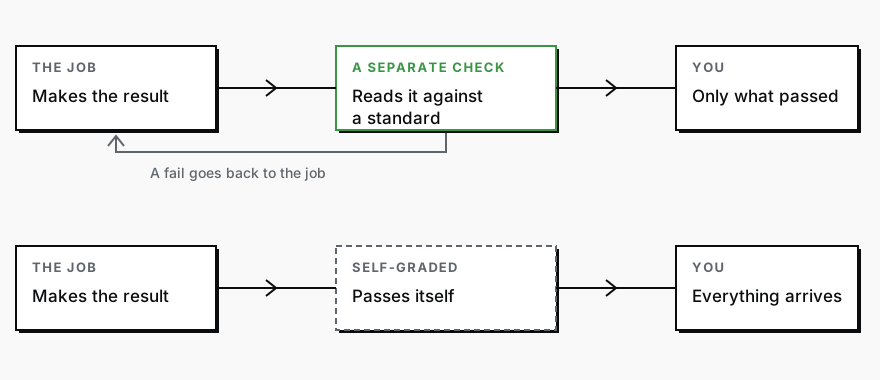
The check has to be separate from the thing that did the work. A job that grades its own output will pass itself. Ask who or what looks at each result, and whether that is a different person or a different system.
The answer you want names a check and says what happens when it says no. The AI that audits the AI describes how that works: a standard set once, applied every time, with a person who owns the pass mark. "We monitor everything" is not an answer. It describes watching, and it names nobody.
Failure is the same question one step later. When the check says no, who is told, how fast, and who fixes it? A good answer names a person or a role and a time: "our operations lead, the same day." "We would look into it" names nobody.
What happens to the jobs if you leave?
This is the question buyers skip, because it feels rude before you have started. Ask three things. Who owns the code the jobs run on? Whose accounts are they running in, yours or the company's? And on the last day, what do you receive: the code, the instructions, the logins, a written description of each job?
Good answers put all three in your hands in writing. If the jobs only run on the company's own system, you are renting them, and stopping means starting again. Some renting is fine if you choose it. Finding out at the end is the expensive way to learn it.
Which answers are red flags?
Four, in the order I would worry about them:
- No answer to who checks the work, or an answer that is the same job checking itself.
- Access to your live systems on day one, with no trial first.
- Code, accounts or instructions that stay with the company if you stop.
- An offer to show you another client's work. Client work is confidential, and a company that will show you someone else's job will show yours. Judge them on how they work and what they put in writing.
The last one surprises people, because a case study feels like proof. Ask for how they would handle your job instead.
The old way, and the one block that replaces it
In the older days you would read the company's website, sit through the call taking notes, then go back through those notes against a list of questions you wrote the night before. Call it three hours for each company you take seriously, and the notes still miss the answer nobody gave.
Today, give Claude, an AI chat assistant, the company's public pages and the call transcript along with the instructions below, and the scorecard comes back in about a minute. Those instructions are what people call a prompt: plain-English directions you paste in.
What comes back looks like this, with invented answers for illustration:
| Question | What they said | Rating |
|---|---|---|
| Before a live job | "We run it on a copy and you approve the first result" (call) | Green |
| Who checks the work | "We monitor everything" (pages) | Amber |
| If a job fails | Not stated | Red |
| If I leave | "You keep the code, the logins stay with us" (call) | Red |
Under the table you get two questions to put to them on a second call, worded the way you would say them.
Whoever handles your vendor calls pastes the pages and the transcript. Most call tools can save a transcript, and if yours cannot, paste your own notes from the call instead. Your part is reading the scorecard and deciding which two questions to ask.
I am a CPG founder deciding whether to hire a company to build and run automated jobs for my business. Below are the text of the company's public web pages and the transcript of my call with them.

Fill in a scorecard with exactly four rows:
1. Before a live job: what the company does before it works on anything real, such as a trial on a copy, a result I review, or my sign-off.
2. Who checks the work: who or what looks at each result after it runs, and whether that is different from whoever did the work.
3. If a job fails: who is told, how fast, and who fixes it.
4. If I leave: who owns the code and the accounts, what I receive when we stop, and who keeps the jobs running.

For each row give what they said, quoted, and whether it came from the pages or the call. Then give a rating. Green means a specific answer I can check. Amber means a general answer, like "we monitor everything". Red means no answer, an answer that depends on trusting them, or an offer to show me another client's work. If the text does not say, write "not stated" and rate it Red. Do not guess, do not compare to other companies, and do not recommend one.

Under the table, list the two questions I should ask on a second call, worded the way I would say them.

Here is the text:
Run it once for each company you are weighing, and the scorecards sit side by side. If a company will not answer a Red row in writing, you have your comparison. The Workflow Build is my version of this work, and these are the same four questions to ask me.
Services
Workflow BuildYou stop doing the job that keeps coming back, and it stops being the thing that slips when the week gets busy. Those hours go back into the work that actually grows the brand.
CPG AI Assessment
Fix the CPG workflow that keeps landing back on your desk.
I map the recurring reporting or operating workflow first, then build only when the first useful fix is clear.