By Smári Ásmundsson · · 6 min read
AI automation specialist: when a CPG brand needs one and what to hand over first
When does a CPG brand need an AI automation specialist, and what should it hand over first?
Say a reorder sits in a retailer's portal for three days because the file that feeds your weekly numbers changed a column name, and nothing told you. That is the week a founder starts asking whether to hire someone for this. A CPG brand needs an AI automation specialist for one kind of job: one that runs on its own, can touch money, customers or retailers, and has someone who can say when it is wrong. Everything else, you or someone on your team can hand to an AI assistant this afternoon. Three questions sort which is which, and the first handover to a specialist is one job, written down as a brief.
Which jobs can a founder hand to AI without a specialist?
Any job where a person starts it, reads what comes back, and a wrong answer costs a second look. A summary of last week's customer reviews. A first draft of a reply to a distributor. A comparison of two price sheets.
Whoever does it opens Claude (an AI assistant you type to, like a chat window), pastes the material in, and reads the answer. Nothing runs while nobody is looking. What to automate first picks among these jobs by the weekly drag each one already causes.
What makes a job worth a specialist?
Three things, and they stack. The job runs on a schedule, so nobody is watching when it goes wrong. A wrong result can reach money, customers or retailers: an order, a price, a message to a buyer, a claim about your product. And someone on your team owns checking it and can say in one sentence what wrong looks like.
A job with none of the three is a chat job. A job with all three is a specialist's job. By specialist I mean someone outside your payroll who builds and looks after one defined job in your own accounts, then hands it over. The tree shows where each job lands.
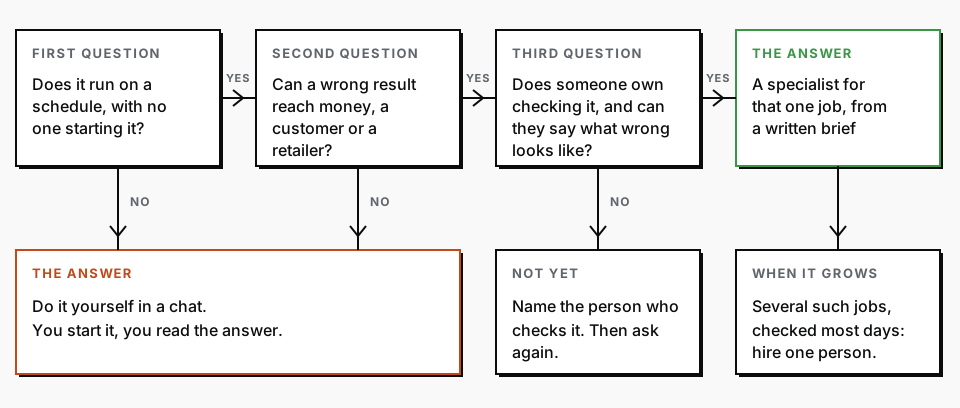
The third question is the one brands skip. A scheduled job that touches a retailer and has no owner is not ready for anyone, specialist or not. Name the person first.
When several jobs land with a specialist and each needs eyes most days, you have a role, not a project. Hire that person, and have a specialist build the first job so they inherit something that works.
What should you hand a specialist first?
One job, not a program. Pick the one that costs the most hours and has the clearest definition of wrong, and write it as a brief: what comes in, what a good result looks like, what must never happen, and who checks it. It is the job description treating AI like a hire asks for.
In the older days you would sort the jobs yourself: list everything your team repeats, work out who starts each one, what it touches and who checks it, then write the brief. That is a day with your ops person.
Today, whoever keeps your team's task list can have the sorted table and the first brief in a couple of minutes. For a frozen meals brand, this is what comes back, starting with the table:
| Job | Runs on its own | Can touch | Verdict |
|---|---|---|---|
| Weekly sales summary | Yes | Nothing outside | Yours, with a weekly read |
| Reply drafts for customer emails | No | Customers | Yours |
| Reorder reminders to buyers | Yes | Retailers | Specialist |
Under the table comes a brief for the specialist job that costs the most hours:
The job: each week, find retail accounts that usually reorder and have not, and draft a reminder for each buyer. What comes in: the distributor's weekly sales file. Good looks like: one draft per account, using that buyer's own item names and the date of the last order. Must never happen: a reminder to an account that already reordered, or a draft that quotes a price. Who checks it: whoever owns retailer accounts, every week, before anything is sent.
Your part is reading the table and the brief, and changing any verdict you disagree with. The person who keeps the task list pastes the text below into Claude, with a rough list of the jobs underneath. (That text is called a prompt: the instructions you type in. Paste this one as it is.)
I run a consumer packaged goods brand. Below is a rough list of jobs my team repeats. For each job, answer four things: does it run on a schedule without anyone starting it, can a wrong result reach money, customers or a retailer, who on my team could check the result, and can that person say in one sentence what a wrong result looks like.

Then sort every job into one of three groups: I do it myself in a chat, bring in a specialist for this one job, or name an owner first. Show the result as a table with one line of reasoning per job.

Finally, take the job in the specialist group that costs the most hours and write a one-page brief for the specialist: what the job is, what files come in, what a good result looks like, what must never happen, and who checks it. Plain English, no jargon. If you are unsure about any answer, say so and ask me rather than guessing.

My jobs:
What should a specialist show before they touch a live job?
A test run on copies of your own files. They run the job on last month's real export (the spreadsheet you download from a portal or a warehouse) and put the result beside what your team produced by hand. Every difference gets explained. Nothing goes live until you have read that page.
Do not ask to see another client's work. Every client's work is confidential, including yours, and a specialist who offers to show you someone else's is telling you how yours will be treated. Ask for the confidentiality terms in writing instead.
Whoever manages your vendors can run this interview. Five questions work for any specialist, and none of them ranks anyone. A good answer follows each.
- Whose accounts does the job run in? Yours, and you own it if you part ways.
- What do you run on our own files before it goes live? Last month's export, with the result next to ours.
- What does the job do when it is unsure? It stops and tells a named person. It never guesses a price or a claim.
- Who is told when it fails, and how fast? A named person, the same day, including when a file changes shape and nothing reports an error.
- What will I read each week? A short summary I can finish in minutes.
How do you check the work after handover?
A common way for this kind of job to fail is not a crash. A file changes shape, nothing reports an error, and the numbers still look plausible. So the check cannot be you looking harder.
Ask the specialist to build three things into the job. A second AI read-through compares every result with the brief and holds back what does not match, the way the AI that audits the AI describes. A short weekly note lists what ran, what was held back and what it was unsure about. And when an incoming file does not look like last week's, the job stops and tells a named person.
Your work shrinks to reading that note. If a held-back result was fine, you tell the specialist once, and they loosen the rule.
If the sort leaves you with a job like that, handing one repeating job off and running it in your own accounts is what a Workflow Build is.
Services
Workflow BuildYou stop doing the job that keeps coming back, and it stops being the thing that slips when the week gets busy. Those hours go back into the work that actually grows the brand.
CPG AI Assessment
Fix the CPG workflow that keeps landing back on your desk.
I map the recurring reporting or operating workflow first, then build only when the first useful fix is clear.