By Smári Ásmundsson · · 6 min read
Zapier AI automation for a CPG brand: when a connector is enough and when to build
Is zapier ai automation enough for a CPG brand, or does the job need something built?
A distributor's reorder email lands on Thursday. A connection you set up in Zapier reads it and writes a line in your order sheet. The following Wednesday you find the line says 40 cases and the email said 4.
Zapier is a tool that passes information between the apps you already use.
Zapier AI automation is enough for a CPG brand when the job moves a fact from one place to another and a wrong answer costs a few minutes to fix. It stops being enough when the job needs judgment and a wrong answer costs money, or when nobody is named to see the failure. Three questions sort every job you run, and the rest of this page shows how.
Three answers, not two
Most advice asks "Zapier or custom?" There are three answers.
A connector is a fixed rule between two apps: when a wholesale order form comes in, add a row to the order sheet and email the warehouse. Zapier calls each saved rule a Zap. There is no judgment in it, so there is nothing for an AI to get wrong.
A checked connector is the same rule with an AI step in the middle. An AI step is one place in the chain where an AI reads something and decides, such as whether a retailer's email is a reorder, a question or a complaint. A person looks at what comes out.
A built agent is a program that takes a whole job, makes several decisions in a row, writes down why it made each one, and tells a named person when something fails.
Three questions sort the jobs
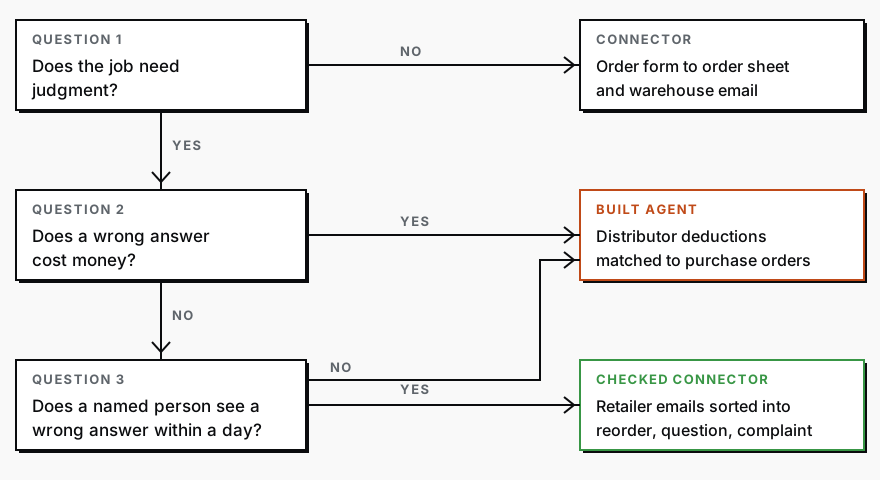
Take any automation you run and ask these in order.
- Does the job need judgment? If a fixed rule can do it, a connector is enough. Stop there.
- If it does, does a wrong answer cost money? Sorting a retailer email wrong costs a few minutes to fix. Matching a distributor's deductions to purchase orders wrong costs a write-off of, say, $1,860 on a $14,000 payment. Those are different jobs, whatever tool runs them.
- Does a named person see a wrong answer within a day? Your ops lead reads the retailer inbox every morning, so a mis-sorted email gets caught. Nobody reads the deduction record until month end, so a wrong call sits there for weeks.
When is a connector with an AI step enough?
When all three hold: the AI step makes one decision, a wrong decision costs minutes, and one named person looks at the output on a schedule. Sorting email, tagging products and drafting a reply that someone else sends all fit. Zapier's own pitch is to add AI "exactly where you need it", and I would hold to that: one step, one decision.
This covers more than a founder expects. A brand whose jobs all sort into connectors and checked connectors has its answer, and Zapier is enough.
What breaks first when an AI step sits inside a connector?
Silence. Zapier keeps a history of every time a Zap ran and marks the ones that stopped, and it emails you when something goes wrong with a Zap that was already running. All of that is built around a step that fails. An AI step that files a complaint under "reorder" has not failed. The run shows green, nothing is sent to you, and the wrong answer goes on to the next step.
The Thursday email is this failure. Because a case count is money, that job sorts as a built agent, not a checked connector.
The second break is slower. A distributor changes the layout of its email, the AI step keeps answering every time, and the answers get worse without anything on screen to show it.
How do you check a connector-based job is still correct?
Treat it like a new hire's first month. Whoever keeps the order sheet owns this check and pastes the last twenty rows the Zap wrote, each beside the email it came from, into Claude (Anthropic's AI assistant) and asks it to list only the rows where the two disagree. That takes seconds, and it runs every Friday for the first month, then monthly. Your part is reading the list it sends back.
Let Claude sort your jobs
In the older days you would open every Zap you run, read its steps, ask whoever built it what happens when it is wrong, and write the answers in a table. Four hours later you have a table of twenty jobs, and half the cells say "not sure."
Today, whoever runs your Zapier account writes one plain line per automation and pastes the list under the instructions below (people call a set of instructions like this a prompt), in a new chat with Claude (claude.ai, a chat window in your browser). You have your table in thirty seconds.
Here is what comes back:
- Wholesale order form to order sheet and warehouse email. No judgment. Connector.
- Retailer emails sorted into reorder, question or complaint. Judgment, a wrong sort costs a few minutes to fix, the ops lead reads the inbox each morning. Checked connector.
- Distributor deductions matched to purchase orders. Judgment, a wrong call writes off money, nobody looks until month end. Built agent.
- Instagram comments sent to a team chat channel. Judgment, cost unclear. Ask: who reads the channel?
Below is a list of the jobs we run on Zapier, one line each. For every job, answer three questions in a few words: does it need judgment or can a fixed rule do it, does a wrong answer cost money or only minutes, and who sees a failure and how soon. Then sort each job into one group. "Connector" means no judgment. "Checked connector" means judgment, a wrong answer costs minutes, and a named person sees it within a day. "Built agent" means anything else. Give me one line per job: the three answers, the group, and one sentence of why. If a line does not say enough to answer, write "ask" and name the missing fact. Do not guess.The part that is yours is reading two kinds of line: every "built agent" and every "ask." Those are the only ones that need a decision from you.
When does the job outgrow a connector?
Four signs. A wrong answer costs money. A second decision depends on the first, so one bad sort triggers a wrong reply. Someone will need to know six weeks later why the job decided what it did. Or the failure needs a decision of its own: retry, ask a person, or stop.
Any one of the four is enough. The work is then a built agent, with a check before each step, a record of what it did and why, and a named person who gets the failure. Zapier sells its own version of this, Zapier Agents, which it describes as AI that takes action like qualifying leads and routing tickets, running in the background. The same three questions tell you whether it is the right one for a given job.
How to manage a built job is in Treat AI like a hire, not a tool. What the second system that checks the first looks like is in The AI that audits the AI. Choosing between tools is in Which AI agents should a small CPG brand use, and how should it choose?
When your table has a built agent in it and you want it built, that is the Workflow Build service.
Services
Workflow BuildYou stop doing the job that keeps coming back, and it stops being the thing that slips when the week gets busy. Those hours go back into the work that actually grows the brand.
CPG AI Assessment
Fix the CPG workflow that keeps landing back on your desk.
I map the recurring reporting or operating workflow first, then build only when the first useful fix is clear.