By Smári Ásmundsson · · 5 min read
AI automation engineer for a CPG brand: the three kinds of work and when to hire
Does a CPG brand need an ai automation engineer, or can the team run agents without one?
A weekly sales report stops arriving in the second week of the month, and you find out when a buyer asks where it is. A CPG brand does not need to hire an AI automation engineer to prevent that. It needs three kinds of work to have an owner each, and it needs to know which signs mean one of them has outgrown part-time help.
What does an AI automation engineer do all week?
An AI automation engineer looks after the tasks you have handed to AI to run by themselves on a schedule, such as the weekly sales report or the order updates sent to customers. I call each of those an automation. The work comes in three kinds: build the automation, watch it, repair it.
Build is setting an automation up so it reads the right files and emails, follows your rules and produces the result, such as the finished report. It is heavy for a few weeks, then stops until the next automation.
Watch is checking, week after week, that the automation still does what it did on day one. It is light each week and never ends.
Repair is fixing it when something it depends on changes. A supplier renames a column in their sheet, and the report quietly fills with blanks.
Which of the three kinds of work can an owner keep?
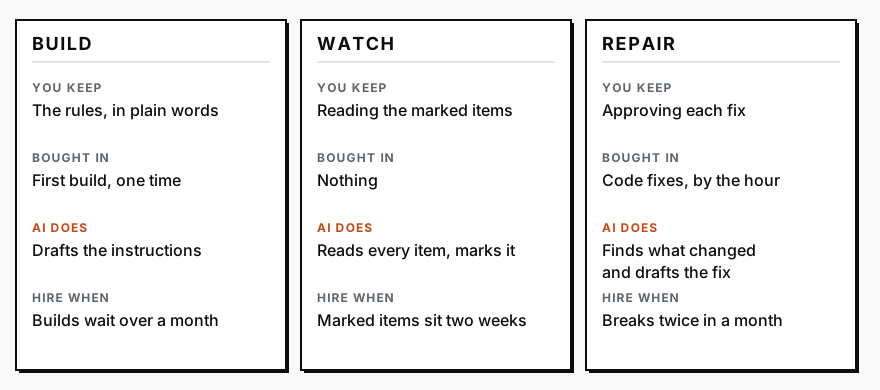
You keep the parts only you can do. In building, that is the rules: what a good report looks like, in plain words. Nobody else knows your buyers. In watching, it is reading the short list of items the AI marks for a second look. In repairing, it is approving each fix before it goes live.
You can buy in the first build as a one-time piece of work, and any fix that needs someone to change the underlying software, by the hour. The AI does the rest. It drafts the automation's instructions from your description, reads everything the automation produced, and works out what changed when something breaks.
That is why part-time help can last longer than a founder expects. These are not three full-time roles. The AI does the reading in watching, drafts the fix in repairing, and you say yes or no. Building is the one that needs a person's hands.
What does an AI watcher do that a person forgets to?
A person reads a sample, and only when they remember. An AI watcher, which here means a chat with Claude (Anthropic's AI assistant) that you hand the week's results to, reads every item the automation produced, and compares this week with last week. It does not decide that things are probably fine because the last four weeks were. That habit is what a part-time owner loses first, and it is the one the AI keeps. A person still has to start it once a week, which takes a minute and is covered below.
The weekly check is covered in the review step that keeps an automated AI task accurate after it goes live. A watcher also has to read the work itself, not only whether the automation ran, which is the point of a post on a system that passed every automated test and still produced junk.
Let Claude watch and propose the repair
In the older days you would open each automation's results on Friday, read a sample of twenty items against your rules, compare them with last week's, and write down what looked off. Two hours per automation, and with five automations that is a day. Today, your operations lead, or the contractor who built them, pastes your rules and the last two weeks of results under the instructions below, in a new chat with Claude (open claude.ai in your browser and start a chat). You have your answer in thirty seconds. (People call a set of instructions like this a prompt.)
Here is what comes back:
- Fine: 41 of 46 report lines match the rules and last week.
- Look: 4 lines show a blank in the cost column. The supplier sheet has a new column order this week. Fix: tell the automation to read the cost column by its heading, not its position.
- Stop: 1 line shows a price of zero on a product that sells. Hold the report until someone confirms it.
Below are the plain rules for one automation, then everything it produced last week, then everything it produced this week. Compare this week with the rules and with last week. Mark every item fine, look or stop. For each look or stop item, say what changed, in one sentence, and write the smallest fix as one instruction a person can hand to whoever runs the automation. Do not change anything yourself and do not guess at a cause you cannot see in the pasted text. End with a one-line count of fine, look and stop.That person pastes it once a week. Your part is the two lists at the bottom: the look and stop items, and the fixes it proposes. Approving a fix is a yes or a no.
What are the signs a brand has outgrown part-time help?
There are four signs. New automations wait more than a month to be built. The look and stop items sit unread for two weeks. The same automation breaks twice in a month for different reasons. Or the part-time person doing the repairs is the founder or the operations lead, and their own work is slipping.
One sign means the part-time setup is stretched. Two means you are paying for the delay in missed reports. That is the point where a hire is the right call, and until then a contractor for builds and repairs, an AI for watching and you for the rules is the cheaper arrangement.
How to manage an automation once it runs is in Treat AI like a hire, not a tool.
When an automation on your list needs building or repairing and you would rather not do it yourself, that is the Workflow Build service.
Services
Workflow BuildYou stop doing the job that keeps coming back, and it stops being the thing that slips when the week gets busy. Those hours go back into the work that actually grows the brand.
CPG AI Assessment
Fix the CPG workflow that keeps landing back on your desk.
I map the recurring reporting or operating workflow first, then build only when the first useful fix is clear.