By Smári Ásmundsson · · 7 min read
Self-hosted AI agents: when a CPG brand should run its own and when not
Should a CPG brand run self-hosted AI agents or use hosted ones?
Most CPG brands should use hosted AI agents: programs that do a job alone, run by the vendor, who fixes them when they break at 6 AM. Run your own, the self-hosted kind, only if data must stay with you, a named person owns the fix, a day down costs real money, and the company owns the logins.
How do you decide between hosted and self-hosted AI agents?
Sooner or later a vendor demos an agent and someone on your team asks whether you should run it yourselves. Ask four questions in order and stop at the first one that gives you an answer. Most agents are settled by the first two. Two of the outcomes end in an exit plan, a one-page note on how you would leave a vendor, and the example below builds one.
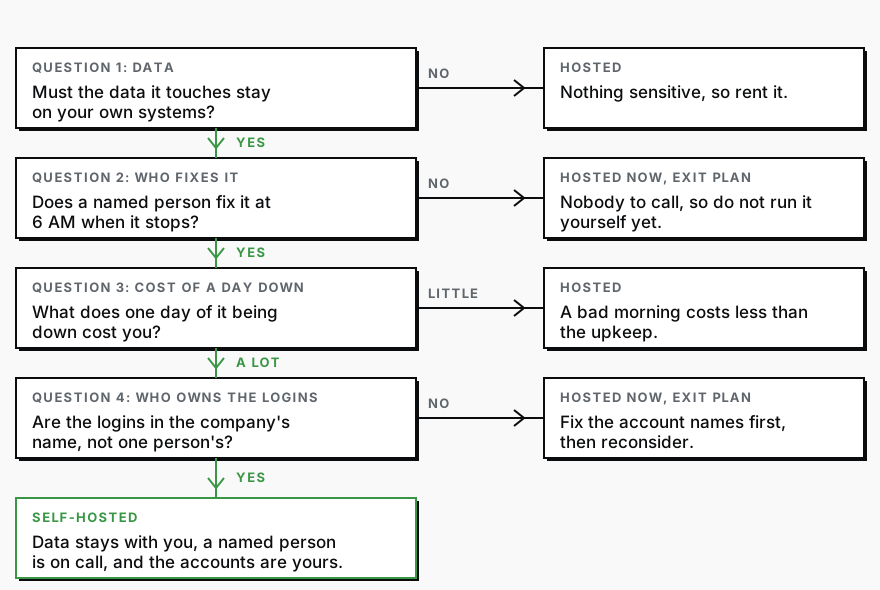
Here is the path with a made-up brand. This is illustrative: Larkspur Granola, a name I invented, wants an agent that reads order emails from retailers and drafts replies.
- Must the data stay on your own systems? The agent would read order numbers, retailer contacts and a customer list. The customer list has to stay home. Keep going.
- Does a named person fix it at 6 AM? Larkspur has an ops manager who is good with spreadsheets and has never kept a computer running around the clock. No one qualifies. The path ends: hosted now, with a written exit plan.
The exit plan says where the agent's instructions are kept, where its results are saved, whose name is on the account, and the date you will look at this decision again. Larkspur gives the hosted agent the order numbers and retailer contacts and keeps the customer list out of it. That is a smaller job than the one they imagined. It is also a job they can walk away from in an afternoon.
The two exits you do not see in that example work the same way. If the answer to the first question is no, the data is not precious, so rent the agent and move on. If a day of downtime costs little, a late report is cheaper than a person's time on upkeep, so rent it.
| | Hosted | Self-hosted |
|---|---|---|
| Who runs it | The vendor | You, or someone you hire |
| Who fixes it when it stops | The vendor, on the vendor's schedule | A named person on your side |
| What leaves your building | Whatever you connect to it | Only what you choose to send out |
| What you can see | What the vendor shows you | Everything it does |
| What you carry | A monthly bill and a vendor you rely on | Upkeep, updates and the early-morning call |
What data should never leave your own systems?
Start with the data the agent would touch, because every later answer depends on it. Customer lists, retailer portal logins, supplier terms and price lists you negotiated are the usual candidates. The test is simple: if this leaked or was read by someone you did not choose, would you have to tell a customer, a retailer or a supplier?
If yes, either the agent runs on your side, or that data stays out of it. The second option is easy to overlook. An agent does not need your customer list to draft a reply about a late pallet. Giving a hosted agent a narrower job is often better than self-hosting it for the full one.
Who gets paged when a self-hosted agent stops?
Being paged means getting the phone call when something breaks. Software stops. A password expires, a connection drops, an update changes how something behaves. A hosted agent has a vendor whose job is to notice. A self-hosted one has you.
So ask for a name, not a team. "IT" is not a name. "Dana, who has fixed this kind of thing before, and a backup for when Dana is on a plane" is. If the honest answer is "I would find out eventually", you are not ready to run it yourself, and nothing about the agent's quality changes that.
The cost of a day down is the second half of this. Put it in plain terms: one missed retailer cutoff, a pile of unanswered customer emails, a purchase order acknowledged a day late. If you can say it in one sentence and it hurts, you want the fastest fix you can get, and a named person on your own payroll may be faster than a vendor's queue. If the sentence is "we would redo it tomorrow", rent the agent.
What does a hosted agent hide that you still need to see?
Three things, and a vendor's dashboard shows you the first one at best.
First, what it actually did: what it read, what it changed, and when. Ask for a running record of its actions and ask whether you can take a copy. Second, what it got wrong without failing. An agent that finishes a run is not an agent that did the job well, a point I made in Green tests measure the wrong thing. Third, what happens to your instructions and results if you leave. If you cannot take them with you in a form you can read, you are renting more than the agent.
A second check that blocks bad output with nobody watching is the fix for the second item, and it works the same hosted or self-hosted. That is the subject of the AI that audits the AI.
When is hosted now and self-hosted later the right order?
Most of the time. A hosted agent lets you learn what the job really needs before you commit to running anything. Self-hosting an agent you do not yet understand means paying for upkeep on a guess.
Hosted has its own way to go wrong. Vendors change prices and terms, and an agent you rent can get dearer or disappear. That is what the exit plan is for.
Move to self-hosted when two things change. The data question flips, because the agent now has to touch something that must stay home. And a named person exists who wants the job and has done it before. That person can be someone you bring in to build it on your own accounts and write down how it works in plain language, but the early-morning call stays yours. Until both are true, hosted with an exit plan is the honest answer, and the exit plan is what makes the later move cheap.
If you are still choosing which job to hand over in the first place, start with which AI agents a small CPG brand should use. This post starts after that one ends, once you know the job and need to decide where it runs.
Can an AI run the four questions for you?
In the older days you would collect the vendor's security page, hand it to your IT contractor, and trade emails with both until someone gave you a straight answer. That is a week of waiting, most of it between replies.
Today you give Claude, an AI assistant you type to like a text message, the instructions below and have your verdict in a few minutes of answering questions. (The instructions you type in are called a prompt; you can paste this one as printed.)
I run a food and drink brand with a small team. I am deciding whether to use a hosted AI agent (the vendor runs it on their computers) or a self-hosted one (we run it on our own computers or on rented computer time we control). Interview me, one question at a time, and wait for my answer each time. Ask in this order:

1. What information would the agent read or change? Examples: sales numbers, customer emails, retailer portal logins, supplier contracts, price lists.
2. Who on my team would fix it when it stops at 6 AM, and have they fixed something like this before?
3. What does one day of it being down cost me, in plain terms such as late orders, missed retailer deadlines or unanswered customers?
4. Whose name are the accounts and logins under: the company's or one person's?

If an answer is vague, ask again instead of guessing. After the fourth answer, give me one verdict: hosted, self-hosted, or hosted now with a written exit plan. Explain the reason in three sentences a non-technical person can follow. Then list what I should ask the vendor to put in writing before I sign. If the verdict includes an exit plan, write the one-page plan for me: where the instructions are kept, where the results are saved, whose name is on the account, and a date to review.
You answer four questions. The verdict, the reasons and the exit plan come back written.
Hand it to whoever on your team would run the agent. They answer the four questions and you read the verdict. One judgment stays with you: whether the data in question one is really that sensitive. Only you know what your retailers would say.
Sources
No outside facts are stated in this post.
Services
Workflow BuildYou stop doing the job that keeps coming back, and it stops being the thing that slips when the week gets busy. Those hours go back into the work that actually grows the brand.
CPG AI Assessment
Fix the CPG workflow that keeps landing back on your desk.
I map the recurring reporting or operating workflow first, then build only when the first useful fix is clear.