By Smári Ásmundsson · · 4 min read
AI agents platforms a CPG brand can run without a developer
Which AI agents platforms can a CPG brand run without a developer?
Your ops manager builds something on a Friday that emails the broker every morning. In week three it stops. Nobody gets an error, and the broker is the one who tells you. Whether that happens to you depends on which of three kinds of platform you picked. Two of the three can run in a seven-figure CPG brand without a developer on payroll.
What are the three kinds of AI agent platform?
An agent is an AI helper that takes a job, uses your other software to do it, and decides some of its own steps. Platforms that build and run these sort into three kinds.
Connector tools pass data from one app to another when something happens, the same steps every time. No-code builders let someone describe a job in plain words and give the AI judgment on messy input, such as reading a retailer email. Zapier Agents and n8n, a similar builder, sit here. Zapier says its agents work across 9,000+ apps. Developer frameworks are code libraries. LangChain's documentation describes one of them, LangGraph, as a framework and says it leaves the design of the agent to whoever writes the code. That is a toolkit for an engineer, not a product for a founder.
Who has to keep each kind running?
Every kind needs an owner, and the owner is the answer to "without a developer."
A connector tool needs your ops lead, who already knows the apps on both ends. A no-code builder needs the same person plus the habit of reading what each run did. A developer framework needs someone who writes code, and that person stays, because nobody else can change what they built. If you cannot name the owner before you buy, you are buying the broker's phone call.
What does a silent failure look like on each?
A connector tool fails by not producing something. The Friday email never sends, and the only signal is an absence. Someone has to be expected to notice an absence.
A no-code builder can fail by producing the wrong thing in the right format. The run finishes, the email goes out, and the number in it is off. This is why a record of every run matters. n8n says you can open any step to see what went in and what came out, and replay any run to find where it broke. Zapier lists monitoring activity among the things you do with an agent. Ask any builder you are considering the same question: where do I see what it did?
A developer framework fails as quietly as its author allowed. It shows what the engineer chose to record and nothing else. If nobody wrote that part, there is no record.
When is a platform the wrong answer?
Two questions in the picture, top to bottom, are the whole decision tree. If neither fits, you have reached the third kind.
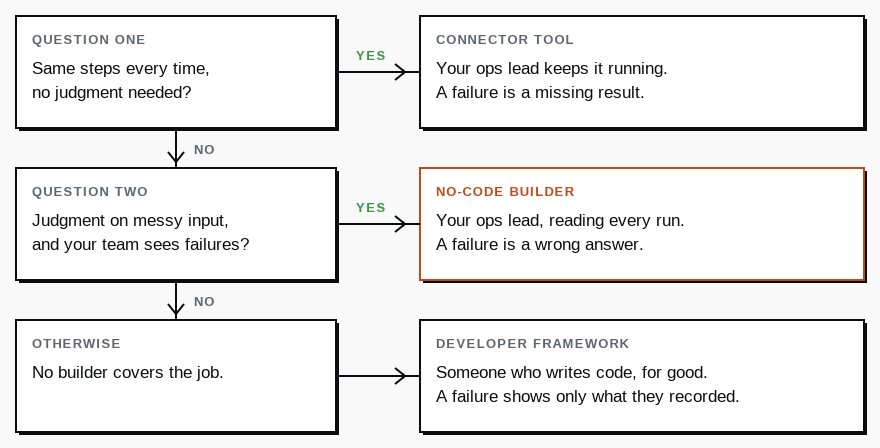
First, are the steps the same every time? Then a connector fits, not an agent. n8n's own page makes the point: a job with nothing unknown in advance needs no AI at all, so it spends no AI budget. Paying for judgment you do not use is the first wrong answer.
Second, does the job need judgment on messy input, and can your team see a failed run? Then a no-code builder fits. If your team cannot see a failed run, the builder is the wrong answer, however good the demo.
If neither question fits, no builder covers the job and you have reached a developer framework. That is where a founder stops. It is a hiring decision, and it is the wrong answer for any job a builder could do.
Three of our notes go deeper on the edges. One covers when a connector is enough and when to build. One shows how a founder judges a no-code agent builder. One is AI that audits the AI, the second pair of eyes for the wrong-answer case.
How do you sort a platform without reading its documentation?
In the older days you would open the vendor's site, its pricing page and a few forum threads. An engineer friend is the next call, to ask what it takes to keep it running. Call it three hours a platform, and four candidates is a week of evenings. You still end with a guess.
Today, whoever on your team shortlists software asks Claude, an AI assistant you type to, and has the answer in about thirty seconds. Here is what comes back for LangGraph:
Kind: developer framework
Evidence: the page calls it a framework and leaves the agent's design to the coder.
Keeps it running: an engineer, permanently.
A failed run looks like: only what the engineer chose to log.
Verdict: stop here unless you have one.
To get that, they paste the platform's home page text into Claude under these instructions. (A prompt is just the instructions you type in.)
Sort the platform described below into one of three kinds: connector tool, no-code builder, or developer framework. Quote your evidence, name who must keep it running, and describe a failed run.You read the five lines and decide. A sort that lands on developer framework means a hiring conversation, not a purchase. Your hands stay off the research.
If the sort lands on a builder, our Workflow Build sets it up with an owner and a record of every run from day one.
Services
Workflow BuildYou stop doing the job that keeps coming back, and it stops being the thing that slips when the week gets busy. Those hours go back into the work that actually grows the brand.
CPG AI Assessment
Fix the CPG workflow that keeps landing back on your desk.
I map the recurring reporting or operating workflow first, then build only when the first useful fix is clear.