By Smári Ásmundsson · · 6 min read
AI automation course: what a CPG founder should expect it to teach
What should an AI automation course teach a CPG founder, and how do you tell a useful one from a generic one?
A course can teach you a lot and still leave the job you wanted automated done by hand. You finish the lessons, and the weekly report, the buyer follow-ups and the reorder check are still done by hand on Friday.
An AI automation course for a CPG founder should leave one named weekly job running by the last session, built on your own business, with a person on your team who owns it afterwards. Judge any course by whether it leaves that behind. If it teaches tools in general and leaves nothing running, it is the generic kind.
What should you have built by the end of a course?
One job, running. A job is something your team does every week: the sales report, the buyer follow-ups, the check on what to reorder. An automation is that job done by a computer for you, on a schedule or when something happens, such as a new file arriving.
Running means four things you can ask the course to show you. The job starts on its own, on a schedule or when something arrives. You can see that it ran. A failure says so to a named person. Someone other than the builder can take it over. Those are the same four questions that decide whether a team can keep an automated job running without hiring a programmer, and that note walks through them. A certificate or a folder of notes is not on the list.
How do you tell a generic course from one that uses your business?
Ask whose files you open in the first lesson. A generic course teaches on made-up example files and a made-up brand, so you learn the tool and then have to translate it. A course that uses your business starts from your own sales files, your product names and your retailer terms.
The reason that matters is that AI knows nothing about your company until you give it that. Asked a question cold, it answers from the category, so you get somebody else's case pack and somebody else's terms. A course that does not start by giving it your facts will teach you to get the average answer faster. A good course starts by writing down, on one page, what your company sells, charges and promises, and this note on teaching AI your business shows what goes on it, and the five instructions a CPG founder should save starts with the one that gets it out of your head.
How much weekly time does a founder need to give it?
Ask any course for its weekly hours, then compare that number with the hours one named person on your team really has free. The founder's own time can stay small if that person owns the job. A course that asks for ten hours and has nobody to spend them is a course that depends on time that does not exist. Whatever the number is, the page should state it. If it does not, that is an answer.
Which path fits: a course, a workshop or hiring it built?
Three questions decide it, and the order matters.
First, can you name one job your team repeats every week that you want AI to do? If you cannot, no path works yet. Name the job first.
Second, can someone give it a set number of hours a week for the length of the course? Third, will one person own the job once it is built? A no to either sends you to hiring it built, which means paying someone to build the job for you. It should hand you the job running, a way to see that it ran and a written handover someone else can follow.
Three yeses mean a course or a workshop on your own business is worth the hours. Either should leave one named job running by the last session. A course taught on example files can hand you the skill and leave the job to you. A workshop taught on your business should hand you the job.
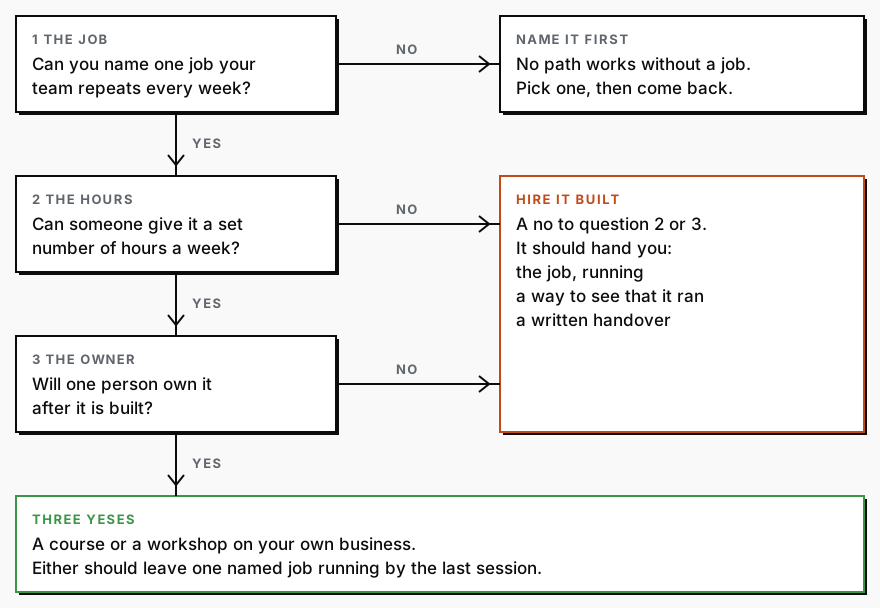
When is a course the wrong choice? When there is no named job, when nobody will own it, and when the job touches a customer or moves money and nobody on your team can check what it produces each week. In each case the tree sends you somewhere else.
Run the tree on your own business, and judge a course with it
In the older days you would do this by reading the syllabus of each course on your list, sitting through the free lesson of each one, and trying to work out from the marketing whether it would leave you with anything built. That is an afternoon per course, and at the end you are still guessing.
Today you give Claude, an AI assistant you chat with by typing, the instructions below and have a verdict on a course in about five minutes. (The instructions you type into the chat are called a prompt. You can paste these as printed.) Hand this to whoever handles your weekly reports. They paste it in, you answer the three questions it asks, and they paste in the course page afterwards.
What comes back looks like this:
Your job: the weekly sales report. Your hours: two a week from one person. Your owner: your operations manager. Path: a course or a workshop on your own business.
This course: the page says lessons use example files from a fictional brand. It does not say a job will be running by the last session, and it does not state weekly hours. It would leave you the skill, not the job.
Open a new chat and paste this:
Help me decide whether an AI automation course is right for my CPG brand, and judge the one I am considering. Ask me three questions one at a time and wait for each answer: what one job does my team repeat every week that I want AI to do, how many hours a week can someone give it, and who will own the job after it is built.

Then tell me in four lines: my job, my weekly hours, my owner, and which path fits. If I could not name a job, the path is to name it first. If I have no hours or no owner, the path is to hire it built. If I have all three, the path is a course or a workshop on my own business.

Then ask me to paste the course page. Judge it by one test: will I have that job running by the last session? From the page alone, tell me what I would have built by the end, whether the lessons use my business or made-up examples, how many hours a week it asks for, and what the page does not say. Where the page is silent, write "the page does not say". Do not guess.
No provider is ranked here, and none needs to be. The test works on any course page you can paste, and on the one you were about to buy.
If the answer is a workshop on your own business, Nordic Navigators runs the AI CPG Workshop.
Services
The AI CPG WorkshopThe AI CPG Workshop: four live weeks with founder Smári Ásmundsson to build your company second brain, commercial workflows, dashboard and automation.
CPG AI Assessment
Fix the CPG workflow that keeps landing back on your desk.
I map the recurring reporting or operating workflow first, then build only when the first useful fix is clear.