By Smári Ásmundsson · · 5 min read
No-code automation platforms: which can a CPG team keep running without a developer?
Which no-code automation platforms can a CPG team build on and keep running without a developer?
No-code automation platforms: which can a CPG team keep running without a developer? Any that answers four questions in writing, and none that does not. I am not ranking platforms, because the part that decides it is not on the pricing page. An automation is a job a computer does for you when something happens, such as filing every new order. No-code means you build one by filling in forms, not by writing programs. It does not mean nobody maintains it. The four questions are who maintains it, what happens when a step fails, how a person finds out, and how someone else takes it over. The platform's public documentation answers most of them. Below is a one-page card that has an AI assistant read that documentation and fill in the four answers, with the instructions to paste.
What does a no-code platform still need a person to do?
Someone has to own it. The platform keeps its own computers running. Everything you built on top is yours: the steps, the connections to your other software, and the decision about what to do when an order or a file arrives in a shape nobody planned for.
Connections are where upkeep hides. An automation that reads your store's orders and writes to a spreadsheet depends on both staying connected. If a password changes or either side changes how it talks to the other, the automation stops. No developer is needed to build it. Someone with a login is needed to repair it.
So the useful question is not whether a platform needs a developer. It is whether a person on your team can see a problem, understand it and fix it in an afternoon.
How will you know when a step fails?
This one decides whether the automation is a help or a liability. A step that fails loudly costs you an hour. A step that fails silently costs you a week of orders that never got filed, found out when a retailer asks where their confirmation is.
Ask three things. Does the platform stop, try again or skip the step when it fails? Does it tell a person, and by what route? And does that route reach someone who is working today, or only the person who built it and left?
What happens when the person who built it leaves?
Treat this as a requirement from day one, not a cleanup. The automation has to be readable by a second person without a call to the first. That means the steps are visible in plain words, the login is in the company's name and not a personal address, and someone is named as owner. A one-page AI playbook is the same idea applied to the AI itself: what it may do, what it reads, who approves.
How do you check a platform before you build on it?
In the older days you would open each platform's help pages and read them for the four answers. You would hunt through pages for what happens on a failed step, find a vague sentence, and go looking for a second page that confirms it. That takes about two hours per platform, and with three on your list, most of a day.
Today you give this to Claude and have the card in a few minutes per platform: the AI takes about thirty seconds, and most of the rest is copying the pages. (Claude is an AI assistant you type to, like a text conversation. A prompt is just the instructions you type in, and you can paste this one as it is.) Open the platform's help pages for steps, errors and sharing, copy the text of those pages, and paste it where the last line says to.
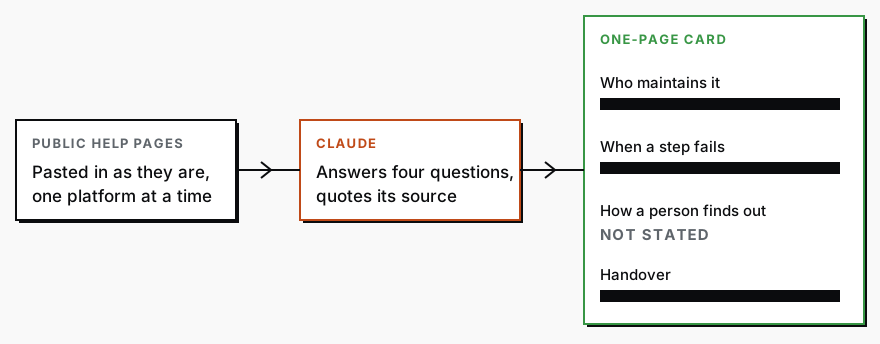
Read the documentation pasted below. It describes one no-code automation platform, a service where you build automations by filling in forms instead of writing programs. Fill in a one-page card with exactly these four rows.
1. Who maintains it: what the platform looks after itself, and what the customer must look after.
2. When a step fails: what happens, whether it stops, tries again or skips, and what happens to the data in that run.
3. How a person finds out: how a failure is shown to a human, and whether anyone has to open the platform to see it.
4. Handover: whether a second person can open and read what was built, who holds the login, and how ownership moves to someone else.
For every row, quote the sentence in the documentation that supports your answer. If the documentation does not say, write "not stated" and nothing else. Never guess and never fill a gap with what platforms usually do. After the four rows, list in one line each the questions I should ask the platform's sales team, one for each row marked "not stated".

Documentation:
[paste the help pages here]
Run it once per platform and put the cards side by side. A card with two "not stated" rows tells you more than a glowing page does, because it shows you what the platform has not committed to in writing.
Here is what a filled card looks like for a made-up platform. Every detail is illustrative.
| Row | What the card says |
|---|---|
| Who maintains it | Platform runs the computers. Customer maintains the steps and the connections. |
| When a step fails | The run stops at the failed step and is marked failed. Not stated: whether it tries again. |
| How a person finds out | An email to the account owner. Not stated: any other alert. |
| Handover | Any user on the account can open and read the steps. The account sits under one login. |
Two rows carry a "not stated", and each becomes a question for the vendor. The last row exposes the real risk: one login owns everything. The card tells you what the platform has promised. What the automation should know about your own business is a separate job, and the AI CPG Workshop is four weeks on that.
Which first automation suits a team learning the platform?
Pick a job that repeats, that costs you a day and not a customer when it goes wrong, and whose result a person reads anyway. What to automate first covers how to choose. A weekly summary of the new orders from your store, sent to the person who already checks them, fits. A job that sends something to a retailer without anyone looking does not, until the card for that platform has no "not stated" on how a person finds out.
Services
The AI CPG WorkshopThe AI CPG Workshop: four live weeks with founder Smári Ásmundsson to build your company second brain, commercial workflows, dashboard and automation.
CPG AI Assessment
Fix the CPG workflow that keeps landing back on your desk.
I map the recurring reporting or operating workflow first, then build only when the first useful fix is clear.